
October 13, 2013
The Wheel: Witness Part IV
Dr. David J. Vaughan
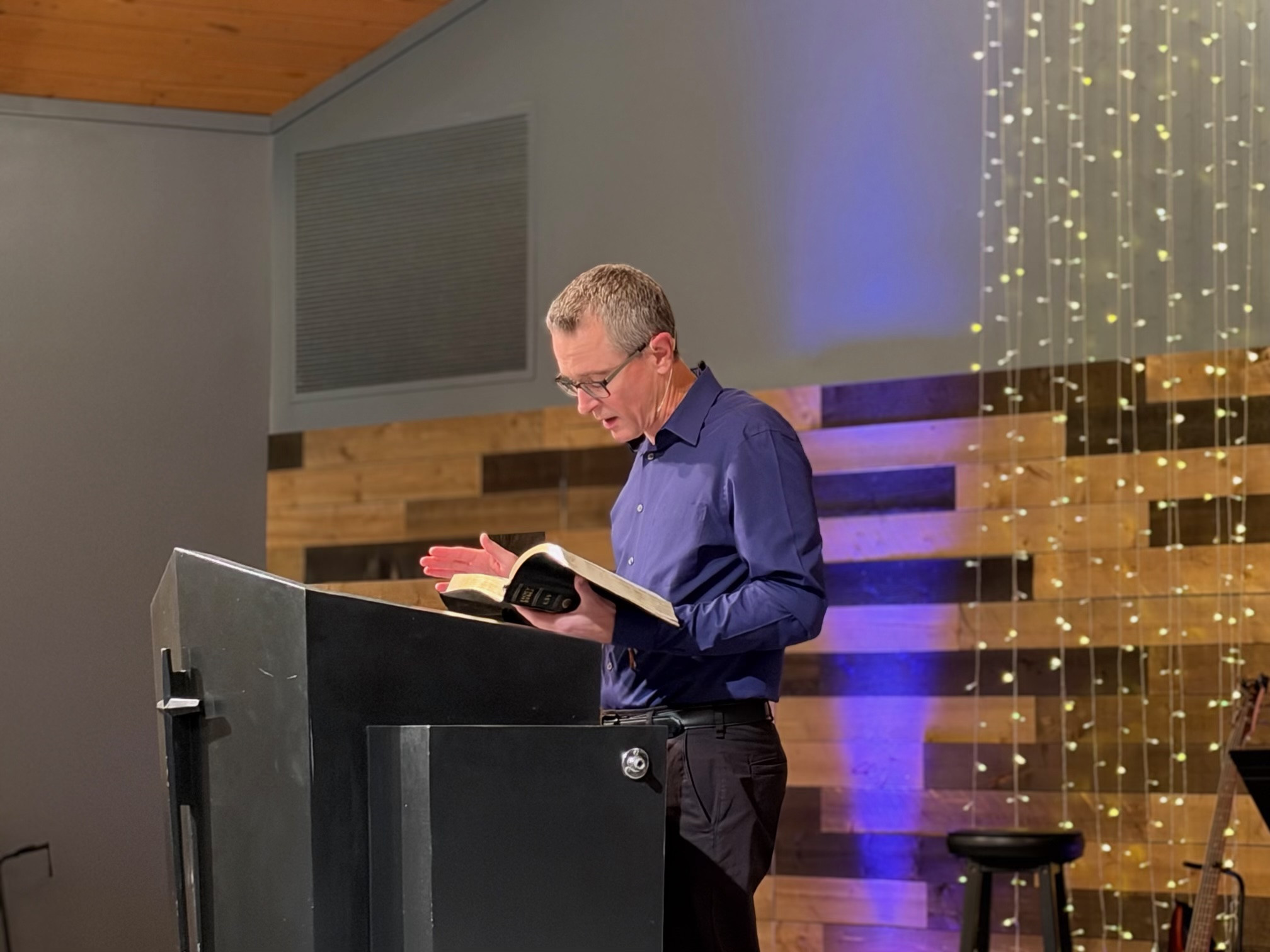
The following is a lightly edited transcript generated from the audio; it may contain small errors.
Okay, if you [audio unclear] serve behind the scenes tirelessly, is that right? A lot. Jake’s been our finance chair for a number of years and has just done a marvelous job. And it’s very time-consuming. So they have meetings up here during the week, taking care of finances, taking care of the facility, overseeing other aspects of ministry. We need to thank them for that. Also want to thank the worship team and thank Rob Witty for all of his leadership in worship. And of course, in order for the worship ministry to move forward, we have to have the support of the audiovisual ministry. And so we have Mike and Justus and others back there leading that. So we applaud them.
Also, we just dismissed the kids. The children’s ministry is a lot of work, and we have catechism for our children. We have nursery. And Laura Dean is my hero, because she does tons of work and she has a passion. And I believe she has the right vision for training our children in the Word when they are young. After the service, why don’t you just walk up to Laura and give her a big hug and say thanks. Thanks for all your work. Also, we want to acknowledge all the work that Cindy Wilson does with the kids’ drama. The last drama was awesome. So that’s a tireless, tireless—I’m going to think about this. I’ll figure it out next week. It’s a lot of work. And Cindy is amazing in the quality of the productions that she puts on. So we thank her for that. You’ll want to thank Sandy later for the work she’s doing even now for the Christmas musical that’s coming—well, presentation we’ll call it. She doesn’t want to call it a musical. The kids will be performing though near Christmas.
We need to thank the people that are involved in outreach. David and Ed, M28 Global, the ZOE project. We have people involved in Ashley, Hannah Vaughan, Sandy, Diane. Just a lot of things happening, a lot of people serving. Of course, all the work being done with our young people in the College of Ministry, Change the Globe, with Mike and with Justus, we appreciate all their work. Amen.
By the way, I thought the wrap thing was going to be like a tortilla wrap. Is that not what it is? It’s not a food contest? No? No, I’m glad I didn’t show up and embarrass myself and say, where’s the food tonight? Where did I say to go? Matthew 28? Of course, since it’s our Mission Fest, we are going downstairs to have great food and a chili contest. But the donations are for ministry. And so if you can’t afford the meal, just have the meal. But if you can afford to give more than the requirement, then give more, because the money is going to go to missions. And I want to talk a little bit today about missions, so I wanted to read with you Matthew 28, starting in verse 18. “And Jesus came and” [audio unclear]
teaching them to observe all things that I have commanded you; and lo, I am with you always, even to the end of the age.
(Matthew 28:20)
[audio unclear] Really, the Christian life can be surveyed by looking at a few simple words in the Bible. And it’s one of those happy coincidences that in English all of those words are single-syllable words. Words like come, sit, walk, stand, run, and go.
The first word of the Christian experience is the word come. God invites us to come into a relationship with Him. Isaiah 1:18, God says to His people, “Come now, and let us reason together,” and though your sins be as scarlet, I will wash them white as snow. And then in Isaiah 55, if you want to turn there quickly, we’re going to look at a number of passages this morning. Isaiah 55 is another well-known text on God’s inviting heart, if you will. Isaiah 55, verse 1, it says:
Ho! Everyone who thirsts, come to the waters; and you who have no money, come, buy and eat. Yes, come, buy wine and milk without money and without price. Why do you spend money for what is not bread, and your wages for what does not satisfy? Listen carefully to Me, and eat what is good, and let your soul delight itself in abundance.
(Isaiah 55:1–2)
Isn’t that good? Come to Me, God says, and I will give you a wealth and a prosperity and a satisfaction and a fullness that you cannot find from bread or wine or any material possession. This is an invitation to relationship with Christ, with God. In Matthew chapter 11, Jesus reiterates essentially these Old Testament calls and invitations. Matthew 11, Jesus, I think I read this last week, Jesus says here in Matthew 11, He says, “Come to Me, all” [audio unclear]
And when you look at the context, clearly Jesus is saying, My yoke is not like the yoke of the Pharisees. Because right before this He’s battling the Pharisees, and right after this there’s this dispute about the Sabbath, and the Pharisees were legalistic. The yoke of Jesus is not a yoke of law and legalism and burden. It is a yoke of kindness, a yoke of graciousness, a yoke of mercy, a yoke of goodness, amen? That is Jesus’ yoke. Now some of you might think, well gee, I came to Jesus and I feel my yoke doesn’t feel that way. That’s because we take the grace of God and turn it into laws and into religion, and become religious. And our religiousness is similar to what the Pharisees devised in their system and becomes a burden. Jesus Christ invites us into a relationship with Him which is, from beginning to end, an invitation to stand and walk and live in grace. That’s the Christian life.
In the very last—go to Revelation 22, in the very last chapter of the Bible, we see this same heart of God where He’s inviting, inviting, inviting. In Revelation 22, verse 16, it says:
I, Jesus, have sent My angel to testify to you these things in the churches. I am the Root and the Offspring of David, the Bright and Morning Star. And the Spirit and the bride say, “Come!” And let him who hears say, “Come!” And let him who thirsts come. Whoever desires, let him take the water of life freely.
(Revelation 22:16–17)
So this is the final invitation, if you will, to come. And so we come to Christ in the beginning of our Christian walk, but in reality, no matter where we are in our relationship with the Lord, no matter whether we’ve been Christians for six days or six years or 60 years, we still come to Jesus. He is still the center of the wheel. He’s the center of the Christian life. And if we try to live the Christian life apart from Jesus, His yoke isn’t easy. It’s only easy as we learn to walk with Jesus in relationship. So that invitation to come is a standing invitation. It’s an invitation to you today, tomorrow, the next day, and the next day. Jesus invites you to come and to fellowship with Him daily. Amen.
The second word is sit. In Ephesians 2, if you want to turn there, and this is a word, whereas come is a word of invitation, sit is a word of completion. In Ephesians 2, we are told that because of the work of Jesus, we are now seated with Him. In Ephesians 2, it says, after saying that we are by nature children of wrath, in verse 4, it says:
But God, who is rich in mercy, because of His great love with which He loved us, even when we were dead in trespasses, made us alive together with Christ (by grace you have been saved), and raised us up together, and made us sit together in the heavenly places in Christ Jesus, that in the ages to come He might show the exceeding riches of His grace in His kindness toward us in Christ Jesus.
(Ephesians 2:4–7)
The word sit is a word for completion. Everything necessary for our salvation was accomplished by Jesus Christ through His death, burial, resurrection, and ascension. Everything. The work of Jesus is finished. We don’t add to it. We don’t complete it. It’s done. And when we’re born again, we’re united to Jesus, and the Word of God says that we have been seated with Him in the heavenlies. We’re seated with Him. This is a place of rest. That’s why Jesus said, Come to Me and I’ll give you rest. Come to Me, not so you can work for your salvation. Come to Me, and by coming to Him we enter into the fullness of His work. “It is finished,” Jesus said on the cross. All of our sins are completely paid for. It is done. But sit, although being a word of rest and completion, doesn’t mean we do nothing, right? Because we’re also told to walk.
We walk out our salvation. And here in Ephesians, as a matter of fact, starting in chapter 4, five times Paul uses this word walk in different aspects of the Christian life. In 4:1 he says, “I, therefore, the prisoner of the Lord, beseech you to walk worthy of the calling with which you were called.” And walk is the word for conversation. Now we use the word conversation today as just talking. But the word conversation originally, and it’s in some of your Bibles still, is the word for not just how we talk, but how we live. It’s a word of conduct. So we’re told to walk worthy of our calling, we’re told to walk in wisdom, we’re told to walk in love, we’re told to walk in various ways. So in one sense we’re seated with Christ, the work is finished, yet we have to walk in this world until He takes us home. Amen. And there’s a Christian way to walk and a non-Christian way to walk.
The other word that speaks to the Christian life is the word stand. This is also used here in Ephesians, toward the end, where Paul says this in chapter 6. After he tells us that we’re seated with Christ, in other words sit, then he says walk, then he says stand. He says this in 6:11, let’s start in 6:10: “Finally, my brethren, be strong in the Lord and” [audio unclear] Everything’s a struggle, because there is an enemy and the enemy is real. There are real spiritual forces in this world which are opposed to the people of God. And the adversary of our souls does not want us full of the Holy Spirit, full of the Word, full of worship, full of faith. He doesn’t want that. He wants us to be discouraged and downcast and downtrodden and walking in unbelief. And so he shoots his darts at us. And they come in many different ways. Sometimes they’re physical, sometimes they’re financial darts, sometimes they’re relational darts, sometimes they’re just that feeling of blah. You know that feeling? Blah. You don’t know why, but it’s just blah. It’s like the devil—you get up in the morning and it’s like the devil just put a blanket over you.
So we have to stand. And what you learn as a Christian is that during those times, if you are consistent and if you will battle, if you will resist the doubt, if you will do what is right, even though at the time you don’t want to do what is right—everything within you may be wanting you not to do what is right—if you will not be governed by your feelings, you’ll find that when you battle and you walk by faith and not by emotions, then you find that you get the victory. And you find that those seasons of battle pass, because the Word of God says, resist the devil and he will do what? He will flee. Now it doesn’t mean he won’t come back later. Because even Jesus, although He was tempted in the wilderness, it says that the devil left Him for a season. So we must stand against the enemy of our souls, and that leads to another important word in the Bible, and it’s the word run.
Look at Hebrews 12 for a moment. Hebrews chapter 12, verse 1:
Therefore we also, since we are surrounded by so great a cloud of witnesses, let us lay aside every weight, and the sin which so easily ensnares us, and let us run with endurance the race that is set before us, looking unto Jesus, the author and finisher of our faith, who for the joy that was set before Him endured the cross, despising the shame, and has sat down at the right hand of the throne of God.
(Hebrews 12:1–2)
So because there is a battle, because we must stand, there are times of confrontation with the forces of darkness, we must be determined in our Christian life. The word run is really a word that summarizes the idea of endurance or determination. You’ve heard it said many times that the Christian life is not a sprint, it’s a marathon. You can be on cloud nine for a week, and then you can be in the valley, boom, out of nowhere. The Christian life is not a sprint, it is a marathon, which means unless the Lord returns—and we don’t know when He’s coming back—but if the Lord tarries and the Lord is gracious to you, you will live 20, 30, 40, 50, 60, 70, 80 years. That’s a marathon. That’s not a sprint.
And it’s sad, but true. Over the years, there are people that I was worshiping with when we were in our 20s, and we were radical, and we were doing street evangelism, and just all kinds of things for Jesus. And they were on fire, and they were doing it, man. They were walking the walk. They were committed. They were sold out. They wanted their lives to count for Jesus. And it’s amazing how many of those people over the years have stopped running. They’re just not running. They were sprinting, and they were sprinting well. The problem is they didn’t understand they’re in a marathon, not a sprint. Paul said at the end of his life, [audio unclear] 2 Timothy 4:5:
Endure afflictions, do the work of an evangelist, fulfill your ministry. For I am already being poured out as a drink offering, and the time of my departure is at hand. I have fought the good fight, I have finished the race, I have kept the faith.
(2 Timothy 4:5–7)
Paul, we know, had many trials and many tribulations, many battles. And yet he endured through it all because he was determined to finish the race. His eyes were on the end, the finish line where Jesus was. He’s looking to Jesus. And so as Christians, we need to have the long view of the Christian life. We need to be serving the Lord daily, yes, but we need to understand that we’re building for really many generations, not just our generation, but our lives need to be consistent over the long haul. And that takes determination, in spite of opposition, in spite of disappointment, in spite of criticism, in spite of the many things that the enemy may throw at you to discourage you. We must run with patience. Amen. The race set before us.
The last word I want to mention is the word go. This was the word I began with in Matthew 28, where Jesus said, “Go therefore and make disciples of all the nations.” When we talk about going, what does it mean to go? The Greek word go means go. Pretty heavy, huh? You like that? It means to go out. It means to walk. It can mean to travel. It can mean to journey. It’s used 152 times in the New Testament, and it almost always means go in the literal sense of the word. So if I were to say to you, go downstairs, that would mean that you would have to [audio unclear] In other words, go where they are. Make contact.
Now it is really interesting when you read the book of Acts, you know there’s a series of expeditions, right? What’s interesting in Acts 1, Jesus gives the Great Commission. And in Acts 1, Jesus gets a little more specific because He says, I want you to go to Judea, Samaria, the uttermost parts of the earth. It’s like there’s three stages of world evangelism. So there’s a little commentary in Acts 1 on Matthew 28 about going. Go to your hometown, go to the further region, and then go to all the nations and go to the world. But what’s interesting about the book of Acts is that the apostles didn’t obey. Did you know that? Spencer’s like, are you sure about that? Because what we see in the book of Acts is that the church in Jerusalem was being blessed, and they were having worship and prayer and they were in the Word and the Lord was adding to the church and they were growing and there was healing and awesome things were happening, and guess what? Nobody wanted to leave. They didn’t want to go. And you know why they eventually went? Persecution. They were persecuted, and we read that after the persecution came, then they started to go. In other words, they got forced out. They got cast out, if you will, into the field.
You know in Matthew 9 where Jesus says, pray the Lord of the harvest so that He sends forth laborers into His field. You know that? You know what the word is there? It’s the word cast out. Pray that God will cast them out into the field. Why? Because they don’t want to go. They have to be thrust out. Right? Yeah, we all know this. Because often the Lord has to push us, if you will, cast us out into the uncomfortable place of witnessing for Jesus. So the apostles didn’t want to go. The Lord set up circumstances, and [audio unclear] He will force them to go—of course He didn’t force them, but He pressured them to go and sent them out. He cast them out into [audio unclear] your life group, or a Bible study, or you don’t bring them into church. Bring them in. As a matter of fact, why don’t all of you just bring one person next Sunday? Can you do that? No? You can’t do that? Why not? Okay, next Sunday is officially Friend Day. Okay, I just made it up. And next Sunday, bring one friend. Can you do that? Just bring. If you don’t, that means you don’t have any friends.
I can preach the gospel to you guys, but that’s not going to lead anybody to Christ, because you already know Christ. So it doesn’t mean we don’t bring them in, we bring them in, but in order to bring them in, we have to go to them first. Now fortunately for you guys, you get to go to your mission field tomorrow morning because you all have one. It’s called work. They have other mission fields called the baseball diamond or the basketball court or the gymnasium or whatever activities you’re involved in. You have a mission field and you’re already making contact. So going, you’re really already there. You don’t even have to go anywhere. Just do what you do, right? Do what you do and you’re already there. But see, the other part of going means not just to go physically, but it means to preach or proclaim. Jesus said, go teach them, right? Go teaching them. Teach them. In other words, the point of going is that once you’ve gone and made the contact, then you can speak to them the good news of the gospel. So Jesus, when He says go, He means go forth and share the gospel [audio unclear]
As I’ve said before, the greatest means of world evangelism is simply and still and always will be one-on-one conversations. It’s always been and it always will be one person proclaiming the gospel to another person. It’s always going to be that way. That’s the way God designed it. As you’ve heard it said before, the church is God’s plan A and there is no plan B. There’s no other plan for the lost to know the gospel. You’re the plan. You are the plan, to go and share the gospel with those who do not know Jesus Christ. As I shared with you a few weeks ago, the word preach means to preach loudly. Now, I’m not saying get together with your friends and scream at them. Don’t sit them down and yell at them. But it means to make the message clear. Some Christians are playing a game of charades. You know how charades works, right? You get the card and you’re supposed to act out something. So you’re acting and then the person guesses what you are, you’re whatever. And so some Christians are doing it. They’re going to work and they’re really good, they work hard, and they’re being their witness. They’re playing charades. They want to say, I’m a Christian, but they don’t want to say it. So they are just doing it. Now you should do it. You should live it. People should see your conduct and say, something’s different about that person. But that in and of itself is not going to convert them to Christ. Matter of fact, for some people, when they see you do your charade thing, they actually think it’s a negative thing because they say, oh, he’s religious.
And a lot of people don’t understand the difference between Jesus Christ and Christianity. They don’t understand that the gospel is not an invitation to Christianity. It’s an invitation to Jesus Christ. One of the biggest obstacles I had in coming to Jesus Christ is that I had grown up in the church, and the church with a lot of traditions, and those traditions were an obstacle to me coming to Jesus. Because I thought the gospel meant come to religious tradition. Well, I lived—that’s the yoke of the Pharisees, right? The yoke of Jesus, the gracious yoke, the kind yoke, is an invitation to come, not to religion. It’s an invitation to a relationship with Jesus. And knowing Christ is where we find rest. Knowing Christ is where we find happiness, peace, joy, all the things the human heart really craves, knowing Jesus. It’s not in embracing of Christianity. When you look at the history of Christianity, it’s not a good thing. Right? I mean, how many people have Christians killed? Enslaved? [audio unclear] All the things that have been done in the name of Christ over the centuries, it’s horrendous. For some people, that’s a problem. So charades, it’s not going to work. You’ve got to speak. You have to speak. So go means go and make contact, but then speak.
The extent of our going is universal. That is to say, when Jesus reiterated this command in Acts 1, He said go to Judea, Samaria, the uttermost parts of the earth. Go to your hometown. What’s your Jerusalem? O’Fallon, St. Peters, whatever. You go there. Go to the next ring, if you will, and then you go to the uttermost parts of the world. The extent of the commission given to the church is as broad and universal as the extent of Jesus’ authority. Did you hear what I just said? The Great Commission extends as far as the authority of Jesus Christ. What did Jesus say? “All authority has been given to Me in heaven and on earth.” That is to say that His authority extends over every nation. Therefore, the commission to the church is to go that far, the uttermost parts of the earth. Now some of you may be called to literally go to a foreign nation. Some of you have already gone to foreign nations, but whether you’re called to literally go, you can go by praying for those that we send, you can go by supporting those that we send, partnering with those that we send overseas.
As we really celebrate going and celebrating missions, I wanted to mention some of the countries that we’ve touched over the years through missionary activity. And I believe we have a slide here. We have supported [audio unclear] Right there, Nancy Bond. We have—Ed [audio unclear] himself has done work and is working with the ministry in Kenya. We have supported Sarah Benson in Sudan over the years. My daughter, Hannah, is currently in Malawi. We have supported work in Papua New Guinea, Haiti, and of course, Belize. Right? So we have been able to touch a number of countries over the years. I’m sorry, the ones over here, the countries are so little, you can’t see the color, they’re lit up. Jesus’ authority is not only over those countries, it is over all the gray area too, amen? That’s the field. It’s a big field. So we’re appreciative of all the work that has been done, and just through our fellowship. There are churches around the world that are reaching out around the world with the gospel of Jesus Christ.
Another way that we’ve also reached out is by going, not only to preach the gospel, but we have gone and brought back. Many people over the years that we’ve worked with and supported, helping them actually adopt children from foreign countries. So over the years we’ve supported adoptions from the Philippines, from Ghana, from Greece, from Colombia, Guatemala, India, Haiti, China—did I say China? And there’s probably some other countries I haven’t mentioned. So that’s another way that we’ve been able to go, is literally go and bring back, and train and disciple. So the Lord has really blessed us in many ways that we’ve been able to have this kind of world outreach. But we should not be satisfied with that, amen? We should continue to send, continue to go, continue to pray, continue to give. And so as we fellowship today, we all get indigestion later. Remember, as I said, if you can give more, we encourage you to give more because this is where the money is going. Money is going so that we can literally send someone or support someone that’s already there on the ground doing ministry overseas.
We also do outreach through Master Plan, our Jerusalem ministry, if you will. David’s done a wonderful job, and I’m going to have him share with us in the next week or two about Master Plan and the number of communities in our area, neighborhoods that we have reached for the gospel. The ZOE project is working with orphanages. Thrive ministry—one of the amazing things about Thrive is not just the thousands of babies that are being saved every year, but it’s the number of women that are coming to Jesus Christ. It’s astounding. They come into the clinic, they’re broken, confused, they’re abandoned, they don’t want an abortion, but their parents are telling them to get an abortion, their boyfriend is saying, get an abortion or I’m leaving you, they feel alone. The staff there, my wife included, they share the love of Jesus and it’s amazing how many [audio unclear] So God is doing wonderful things in terms of reaching the lost.
Final word. It’s one of those happy coincidences of language that the Greek word go can also be translated come. So depending on the context, sometimes you would translate it come and sometimes you translate it go. And I think that’s really cool because it completes the circle where we began. We go and we tell people to come, right? Come to Jesus. You know what? We need to come to Jesus too. Because some of us aren’t going for Jesus because we’re not coming to Jesus. You hear me? You’re not going to care about—listen, let’s just say it frankly. This is why people don’t like my preaching, by the way. I’m honest. I’m going to just say it frankly. The reason that a Christian doesn’t really care that his coworkers go into hell is because that Christian is not close to Jesus. In myself, I don’t care about other people. The human heart is selfish. And if you don’t think your heart, apart from grace, is selfish, you haven’t taken a look in the mirror. We’re selfish by nature. What is it that can tell somebody to go to the other part of the world and sacrifice everything to preach the gospel? What is that? Is that human nature? It’s the love of Christ constrains us, Paul says.
And the reason that the kingdom is not expanding in America—and I’ve shared this a little bit last week—it’s not growing in America. Some churches get real big and some churches get real small, but that’s because churches just steal sheep. The kingdom in America is not growing. This has been established. I’m not saying people never get saved, but when you calculate the Christians and the born-again rate of other people coming in, the kingdom is really not expanding in America. And a lot of the problem is that Christians in America, they just don’t share the gospel with anybody. They just don’t. So then you just scratch your heads and say, well why? What’s the problem? Well I can guarantee you that if you get close to Jesus Christ and you walk with Him, you say, Jesus, share Your heart with me. Jesus, share Your heart with me. What do You care about? You will get a heart for the lost. That’s what will happen. It will happen. So, if we’re going to go, we Christians are going to go, we have to come. We’ve got to spend time with Christ. We’ve got to be in the Word and in prayer. We have to be open to whatever the Holy Spirit wants to do in our lives. We need to be yielded and submissive to God’s work in our life. And when you’re close to the Lord, He gives you a concern for the lost that you don’t naturally have. And He also gives you a power to speak His Word.
You, every one of you, I’m talking to you, okay? I’m not talking to the person next to you. Every one of you can bring people to Jesus Christ. You can do that. Or should I say, God can do that through you. And some of you have. Some of you have that passion. Some of you have led people to Christ and you know the joy of doing it. And it’s a wonderful joy. But every one of you God wants to use. And my final exhortation is let’s come to Jesus. Let’s spend time with Jesus, not just corporately but alone, and ask Him to give us His heart. And when He gives us His heart, then we can light up all of those gray nations too. You can light up the people in your workplace and the people in your community because the love of Jesus will cast you out.
Let’s stand and pray. Lord Jesus, I thank You that Your yoke is gracious, Your burden is light, or that Your yoke is actually a blessing. That Your yoke, although it’s a symbol of labor, Your yoke brings rest. Lord, we don’t understand it, but we know it’s true. And I pray for every one of us, myself included, that we would be yoked to You, meaning, Lord, we would submit. We would truly come to You in fellowship, that we’d seek You in our hearts, that we’d spend time in Your Word and in prayer, that we’d learn of You so that we would truly know that Your yoke is gracious and Your burden is light. And Lord, I know that if we spend time with You, You’ll give us a heart for others. You’ll give us a heart to minister to our fellow Christians in the church, but You’ll also give us a heart for those around us that don’t know You. Father, I pray that You would send forth laborers into Your field. And I pray that each one of us would say to You, Lord, here I am. Send me. And we would go wherever You lead. Father, I ask You to bless our fellowship, bless the food we’re about to eat to our bodies. I ask that we would give generously, Lord, and You would use these funds to further the expansion of Your kingdom and the glory of Your name. We pray in Jesus’ holy name, and all God’s people said, amen.