
March 9, 2018
LFC2018: Doxological Hospitality
Guest Speakers
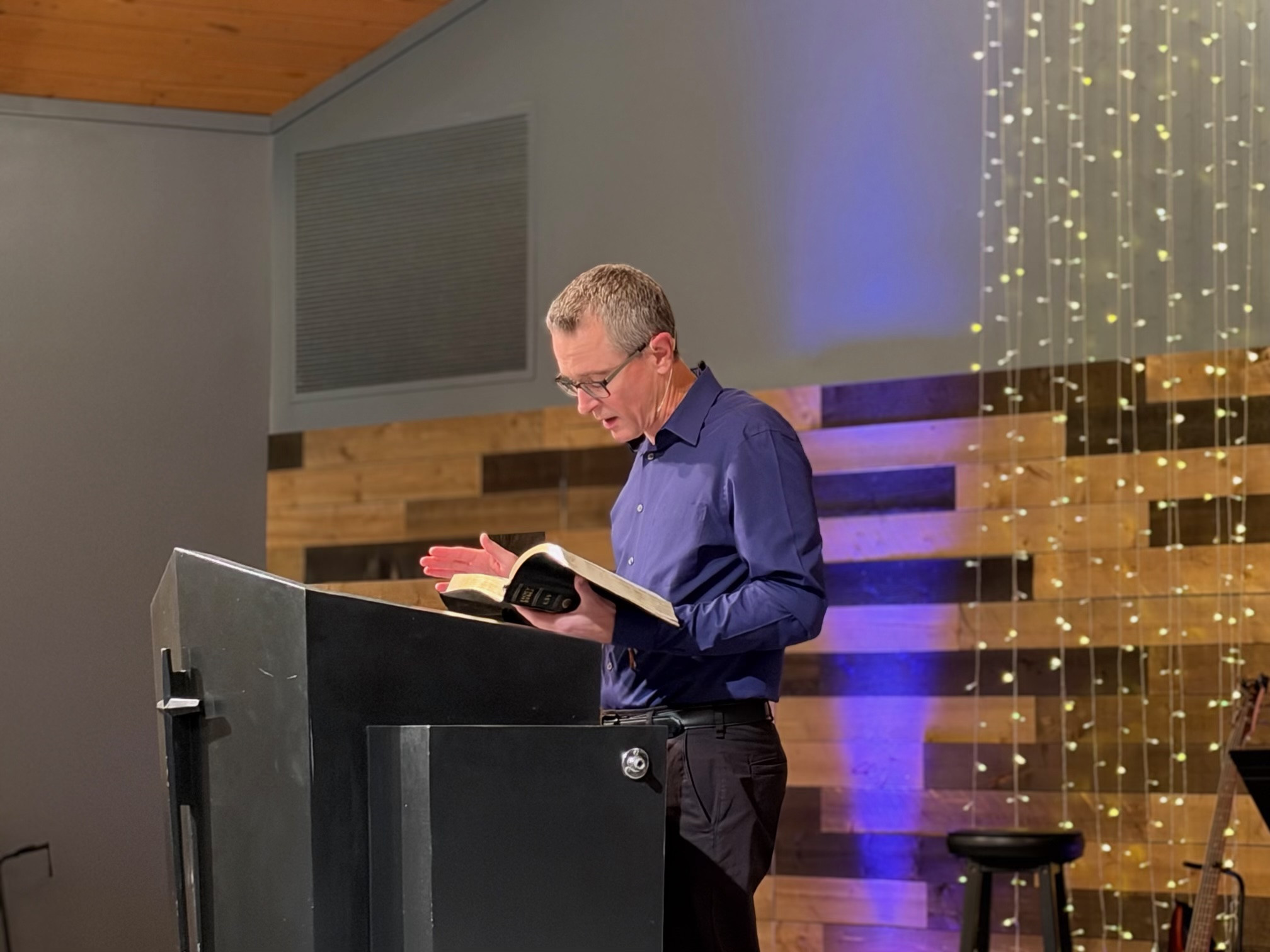
guest speaker Joe Braden
The following is a lightly edited transcript generated from the audio; it may contain small errors.
You would have others tweet about you. Isn’t that what the Bible says? Or something like that. Yeah, I’m using the ESV and Pastor Vaughan is upset with me already. All right. Hey, guys, appreciate the chance to be here tonight and to be back. On the one hand, I feel like we’re annual friends. About once a year, we get to see each other. And I guess for most of my friends, that’s how it is. But we’re grateful to be here to share the evening with you guys.
We appreciate the ministry of Liberty Christian Church. We appreciate the ministry and the friendship of Pastor David and Diane as well. And so I did have a great interest in preaching to you tonight, and although that is honestly waning right now, with that chocolate cake back there, I just wish somebody will save me a piece and then I’ll be okay. If you have your Bibles, turn to 1 Peter chapter 4.
I want to just kind of stand on the shoulders of what Pastor Vaughan has done in getting us started and thinking about hospitality, and I want to add some more things to our conversation for this weekend. The first thing we do then is see what God says to us through His word. And this is what God says. The end of all things is at hand. Therefore be self-controlled and sober-minded for the sake of your prayers.
Above all, keep loving one another earnestly, since love covers a multitude of sins. Show hospitality to one another without grumbling. There’s what our focus is going to be for a little bit tonight. Show hospitality to one another without grumbling. As each has received a gift, use it to serve one another as good stewards of God’s varied grace.
Whoever speaks, as one who speaks the oracles of God; whoever serves, as one who serves by the strength that God supplies—in order that in everything God may be glorified through Jesus Christ. To Him belong glory and dominion forever and ever. Amen. So Father help us now as we look at your holy word. There’s no word like your word and we would ask now that the same Spirit of God that moved Peter to write these words would now move in our hearts in our midst.
That we would spend these moments together in a way that would honor you and that these moments together would move our hearts to honor you even further in how how we would therefore live. We pray this in Jesus’ name, amen. Our passage starts off with this bold declaration, the end of all things is at hand. In between the time from when Jesus ascended to the time that he will return, these times are called the last days of the end times.
The end is near, Christ has promised to return. And what our passage does though is it doesn’t linger long of fleshing out the details about the return of Christ, it just states that it’s imminent. But what it does do is give us some practical direction on how we are to live in light of the imminent return of Christ. What should we be about in light of Christ’s imminent return?
Well, and before I get into the text, I’m going to kind of preface some thoughts here for a little bit. What we should be about in light of the end corresponds to what Jesus had directed us to be about before he physically ascended. What did he tell us before he left?
Go therefore and make disciples of all the nations, baptizing them in the name of the Father and of the Son and of the Holy Spirit, and teaching them to observe or to obey all that I have commanded you. We are to make disciples. Making disciples is a highly relational assignment. Making disciples, which entails processes of going and baptizing and teaching to the point of obedience, involves two phases.
The first phase of disciple making, as reflected in the term go or going, assigns that each of us, each of us who name the name of Jesus, Each of us who are followers of Christ, each of us to reflect the phase of going are called to reach out to those around us who do not know Jesus. Reach out to them, calling them to begin following Jesus in light of the gospel, in light of what he has done for us.
Calling them to begin following him in light of the gospel with the intent of seeing them identify with Christ and being incorporated into a local body of believers. When you and I reach out to those who do not know Jesus, calling them to follow Jesus in light of his gospel with the intent of seeing them identify with Christ and be incorporated in the life of a local body of believers, that reaching out is phase one of disciple making.
The practice of hospitality should and can play a crucial role in phase one discipleship. As we love and as we care and as we serve those who do not confess Jesus through the work of hospitality, we create a relational platform to engage them with the gospel. We show and we tell.
But others this weekend are going to serve you in the area of hospitality for the purposes of reaching out, for the purposes of phase one discipleship, for the purpose of leveraging this role, this thing called hospitality for the purposes of loving on people who don’t know Jesus. My assignment tonight is to serve you by thinking about the practices of hospitality with each other. Really what I would think of as what I’m going to call phase two discipleship.
The practice of hospitality in phase two discipleship is also the platform by which we would engage in this level of discipleship. It too is a highly relational assignment. What I’m calling Making disciples in phase two, we are called to help each other. Those of us who gather together and name the name of Jesus, we are called, each of us are called to help each other in grasping the teachings of Jesus to such a point that we begin to obey the teachings of Jesus.
Thus, each of our callings as disciples is to simultaneously engage in relationships that might reflect a phase one kind of discipleship, reaching out to those who don’t know Jesus, but also a phase two kind of discipleship, remaining with those who do know Jesus, those those whom we share life together in the context of a local church. This too is a highly relational assignment. This too is greatly aided by the practice of hospitality. So what does it mean to engage in the second phase of disciple making?
What does it entail to say that we not only reach out to those who don’t know Jesus, we remain with those who do know Jesus. Well, there’s going to be very similar functions really between phase one and phase two, but the actions are very, very similar. It’s just the audience is different.
In phase one, we’re reaching out to those who don’t know Jesus with a call that they begin to follow Jesus in light of the gospel with the intent that they identify with Jesus and are incorporated into the life of a local body of believers. Phase two is that we remain with those who do know Jesus, and what do we do with them? We are assigned the disciple-making role in their lives to call them to continue following Jesus. See, there’s really two kinds of people.
Continue following Jesus as we expand and understand even further what it means to follow him in light of his gospel with the intent of seeing them persevere in identifying with Christ and become even more deeply incorporated into the life of a local body of believers. So reach out, remain with. Same message. Follow Jesus in light of the gospel. begin doing that or are doing that. And the purposes are similar.
We call people to follow Jesus in light of the gospel because we want them to identify with Jesus and His church or we want them to continue and persevere identifying with Jesus and His church. And And in either phase, phase one, reaching out, phase two, remaining with hospitality can and should play a crucial role until the Lord comes.
So with that said, now we can take a little bit closer look at 1 Peter chapter 4. I want to preface my, my the first, my first point I want to make is that hospitality is a part of our calling. Until the Lord returns, you’ll see a list of five or so things here. Be self controlled, and sober minded. Above all, keep loving one another. Show hospitality to one another. As each has received a gift, use it to serve one another.
You see, in the middle of these things that we’re directed to do to be self-controlled, to be sober-minded, to love one another, to use our gifts to serve one another, we are instructed in the center of all of that to practice hospitality with one another. All of these have an interconnection, sober-mindedness and self-controlled life and a life that loves others in a life that uses our gifts to serve each other. All of that is interconnected even with this work of practicing hospitality with each other.
Hospitality as Pastor Vaughan has already kind of begin to scratch out a process of understanding it entails us wishing to push back on hospitality, particularly as it relates to us remaining with each other, us helping each other as those who name the name of Jesus. It begins by us resolving to push back on the superficial casual relationships that even exists with those of us who belong in the same church together.
It summons us to deploy our time, our resources, our leisure, our home, to deploy all of those things for the purpose of drawing people closer into our lives and moving closer into people’s lives. Why, Pastor Vaughan alluded to it, why would we use these good things like our time and our resources, our leisure, our home to mess with people? Why? Because people and And relationships are more important than our time and our resources and our leisure and our homes.
The early church met together daily, we’re told in the book of Acts. They did that in different contexts. Sometimes they all showed up together in the temple courts. Sometimes they showed up over at Solomon’s Portico. I would guess that even more frequently, they met together in people’s homes. And this is really the realm that we’re kind of directing our thought to when we think about the New Testament’s admonition to practice hospitality.
We’re really talking about the work of drawing people into our lives and moving into people’s lives in more intimate, closer, smaller clusters of relationships. Nothing wrong with us gathering in larger gatherings. Nothing wrong with that. I think it’s a part of the means that God uses in our gathering together to worship Him and to be instructed from God’s Word.
And yet we have to recapture how special it is that God calls us to practice hospitality with each other who already named the name of Jesus, that we would care for each other. It’s more than just mere entertainment, although I’m certainly not opposed to us getting together and experiencing entertainment.
But hospitality that we’re describing here is that we are leveraging our time and our our resources and our leisure in our home to help serve others that we could be using those resources to profit others for the purpose of their discipleship. Loving service to others. Opening up our homes, opening up our lives, opening up our hearts for the purpose, purpose. a godly conversation. Alexander Strauch has written a book called The Hospitality Commands, and here’s what he says. It’s a little bit longer quote.
I don’t think many Christians today understand how essential hospitality is to the fanning the flames of love and strengthening the Christian family. Hospitality fleshes out love in a unique and uniquely personal and sacrificial way. Through the ministry of hospitality, we share our most prized possessions, our family, our home, our finances, our food, our privacy, our time. Indeed, we share our very lives. Hospitality is always costly.
Through the ministry of hospitality, we provide friendship, acceptance, fellowship, refreshment, comfort, and love in the richest and deepest ways possible for humans to understand. Unless we open the doors of our homes to one another, the reality of a local church as a close-knit family of loving brothers and sisters is only a theory. Hospitality entails, he writes, intimate relationships care for one another, knowledge of one another, belonging to one another, sharing life together.
We cannot grow or grow close to our brothers and sisters by meeting in an hour in a church sanctuary. He’s not saying that’s wrong, he says, it’s not enough. The home is the ideal place in which we build relationships and closeness and in most instances we hardly know one another until we get close together in one another’s homes, eat together and talk to one another across the table. So when it says practice hospitality as our calling, that’s what we’re talking about.
About leveraging our lives and our time and our resources and our leisure and our homes and our very lives for the purpose of serving others, for the purpose of having. The platform to have godly conversations with each other. Listen to some of the language of the New Testament. of the, if you would, one anothers in which we are to one another each other. And I’m not sure it would be a smarty pants, although that seems to be one of my spiritual gifts.
But in the three passages I’m going to give to you, these are not directed to pastors. These are directed to what the people of God are to be and people of God are to be and to do with each other. Ephesians 4, 15-16, rather speaking the truth in love, every follower of Christ is assigned to speak the truth in love to other followers of Christ.
Rather speaking the truth in love, we are to grow up in every way into Him who is the head into Christ, from whom the whole body joined together and held together by every joint with which it is equipped, when each part is working properly, makes the body grow so that it builds itself up in love.
One of the one anothers that we are to one another with is we are to be people who are leveraging this work of hospitality for the task of a godly conversation of how do I speak the truth in love to my brother, our sister, to whom I am opening up my home and my heart and my life with.”
Or Hebrews 3, 12 through 13, says, take care brothers, lest there be in any of you an evil, unbelieving heart leading you to fall away from the living God, but exhort one another every day daily. Yeah. As long as it is called today that that none of you may be hardened by the deceitfulness of sin.
We’re not only to speak the truth and love to each other, but since each of us still have the remaining vestiges of a gunky flesh lingering around in us, we each have to take care lest there be an evil, unbelieving heart. Isn’t it interesting? Hey believers, take care, or there’ll be an evil, unbelieving heart that rises up within you. Oh gosh, I don’t want that. What’s the remedy? speaking into each other’s lives.
But encourage, but exhort one another every day, as long as it’s called today, that none of you may be hardened by the deceitfulness of sin. Guess who the sin in your heart deceives? Not me, you. You guys have had too much chocolate cake. I know what you mean, but… The deceitfulness of sin in your heart deceives you, and the problem with deceitfulness is you never see it coming.
You’ve had those conversations on the way home after church, and you say, you know what, I’m concerned about Sister so-and-so or Brother so-and-so, I don’t think they see what’s lurking in their heart.
Of course they don’t see it But that’s why God wants you to practice hospitality in their lives So that as you love on them your hospitality is a platform through which you could show them what you see That they don’t see and guess what though they were they were probably driving home thinking the Just a thought Or Hebrews 10, and let us consider how to stir one another up toward love and good deeds, not neglecting to meet together as the habit of some, but encouraging one another.
All the more, the day drawing near. In light of the end, the end is near, Peter tells us. In light of the end, all the more should we be encouraging one another. We should be considering how to stir one another. So as we went to practice hospitality, not only are we fixing the snacks or fixing the meal or making the arrangements of tidying up the place or whatever we’re doing to get ready to do the hospitality thing. Another thing we’re doing is, Joe’s coming over tonight.
I’ve got to consider what I could do or say to Joe that might stimulate him toward love good deeds. And since Joe’s a hard nut to crack, I better think long and hard about this one. But some people would be easier, you don’t have to think as long and hard about it. But do you see what he’s saying there? He’s not saying, now Pastor Vaughan, make sure you do this work of stirring people up to loving good deeds.
Now he is to do that, but he alone is not to do that. We are to do that. Each of us who named the name of Jesus are assigned this wonderful task of doing that in each other’s lives. What are we doing or saying in each other’s lives? It’s stimulating, exciting, igniting someone to say, that’s it, I’m outta here, I’m gonna go do some loving good deeds. Yeah. Yeah. Whoo. Whoo. Whoo. Whoo.
Doesn’t say, now Pastor Vaughan, make sure you take care of all, all those people who’ve got deceitfulness of sin in their hearts. Now, he is to do that, and he should have a burden to do that. But what this passage is saying is that, We each of us who name the name of Jesus are to say, oh God, I’m burdened over my brother or sister, my friend in the Lord. They’re being hoodwinked by sin in their lives. They don’t see it.
And so Lord, use me to exhort them, to love them and let me use this wonderful blessing of hospitality to leverage that as a platform that I can speak into their lives. Doesn’t just say, Pastor Vaughan, make sure you speak the truth in love.
Now, he certainly is to do that, but it’s saying to each of us who named the name of Jesus, every single member of a part of Liberty Christian Church, whether you have a mug or not, are nevertheless called to speak the truth in love to each other. Why so that we would be built up, that we would grow up in Christ as each part does its work? So, that’s a bit of our calling in terms of even the purpose of that calling.
And yet, when you get down through the nitty-gritty, to be able to speak those kinds of things in each other’s lives, we have to have the relational capital to do so. Because sometimes we’ve got to say aggressive things and hard things and stout things and Sobering things. So we need relational capital. How we love each other through the practice of hospitality can help build that relational capital. It can help give us that passport into each other’s lives. It can help create that intimacy.
So I’m not just saying, you know I love you before I wreck you upside the head. But we show you, I love you because I am serving you. So that sort of work of hospitality requires planning. In fact, who would the Spirit of God be prompting in your heart right now as you think about this message? Say, Lord, in my notes, I’ve got to write down some names of some people that I want to show hospitality toward.
And then Lord, I’m gonna look at my calendar and I’m gonna figure out some dates that I could kind of block off to do that. So Lord, give me my membership directory and give me my calendar and Lord, from that, let me start to mark off names and people and dates and times that I can be intentional about this plan that I want to serve them.
I want to open up my heart, my home, I want to leverage my time, my resources, my life, my family, I want to do that. Why? Because I want to arrange a context of love in which we can have godly conversations because we are smack dab in the middle of phase two of discipleship, of remaining with each other. And not only should we know that purpose and have that plan, but we should realize that this calling of practicing hospitality requires perseverance.
Boy, it’s just a whole lot easier preaching on the need to practice perseverance than it is to practice perseverance. Part of that is because people are crazy. I mean, it requires work. It requires work to come up with that list of people and to come up with the dates and And then to make all the arrangements that we need to leverage to have that platform for hospitality. It requires the work to say, how can I serve them both with my hands and with my lips?
And how can I care for them? How can I love them? It requires work. It requires discipline. It requires determination. And it includes frustration. And it includes weariness. But since it’s our calling, we are to persevere in every one of our callings.
Second thing I want to talk about just for a little bit is not only that hospitality is part of the call that each of us have, but hospitality gets impeded by a host of challenges. And I won’t scratch out all of those challenges. But I’m going to mention four, maybe five challenges. And I’m going to do that on the level of just sometimes we’re not aware of where we’re living and how where we’re living affects us.
In other words, we’re not aware of how the mindsets of the culture around us invades our own thinking and distorts our own thinking and makes it sub-biblical at times. But it’s just a part of the air we breathe and so it just feels natural to think this way, this way. And so there’s four and maybe five mindsets that are contrary to the practice of hospitality. Four or five mindsets that impede how we practice hospitality.
And these are like fancy terms, you know, because my mom and dad spent a lot of money to send me to college, and then Diane and I spent a lot of money going to seminary. And so every now and again, I have a right to use big words. It cost a lot of money to use these kind of words. So that doesn’t mean you can use them unless you spent this money, but I can use them.
So the first is we live in a culture of consumerism. Consumerism. Now, that’s a wonderful thing in a broad sense. I mean, look at all of the nice things we get to go to the store and buy. They’re already made for us. We don’t really have to create anything no more, do we? I don’t have to build a bed, just got to go to the bedroom store and buy one. You know, wow, how easy is that?
You know, so there’s certainly blessings with the consumer culture, but we don’t create anymore, we just consume. But that creates a bit of an ethos, breathing that air, and we begin to think, I exist to be served. I exist to be served. We just breathe that in and after all the customer is always right. Now, when that kind of mindset creeps into the body of Christ, Houston, we have problems.
One of the challenges of being church in a suburban context is we are neck deep in breathing in the air of consumerism. Look, here’s the funny thing about consumerism. We are all made in the image of God. We are all made for relationships. We all want relationships. We all want friendships. We are all made to feel good about being close to people.
But if we look at the work of relationships through a consumeristic mindset, if we treat relationships like consumers, we’re going to be left dangling because relationships not a commodity that we purchase and consume. Relationships are something that we must create. We don’t wait for it to come to us, even though our hearts yearn for it. We’re called to create it. Another mindset is individualism. We are a culture of individuals. We don’t see the need of fussing with others.
We don’t see the need of living in community. I am my own man. I am the master of my fate and the captain of my ship. I don’t need you.
A couple of years ago we were playing with the grandkids and Andrew and Casey had built a teepee in the living room, a large teepee in the living room and so we were playing in the teepee in the living room and my grandson Jett just about tore the teepee down, so I had to get after him and said, Jett, careful, you’re going to tear the thing down. To which my grandson Crew said, Papa, you do not talk to us like that.
Besides, I’m not going to be your friend no more. Now as a grandpa, I just thought that was so cute. If I was a parent, I’d be like, that’s the last thing you just said. But… But… My business is my business. It’s not your business. Get out of my business. I don’t need you. I don’t wanna be your friend no more. Listen, the gospel does save us as individuals, but it saves us as individuals and creates community for us to live in.
None of us wants to feel lonely. All of us wants to feel loved. I think we were made in the image of God to that end. But we have to break through the false notion of individualism that only creates loneliness. We were not made to live by ourselves. we were made to lovingly move toward others and to move outside of ourselves into the lives of others.
And when we think of ourselves, , and even when we think of our faith in merely individualistic terms, then we have this mindset, I don’t need you, I got Jesus. Well, Jesus says you need me. Well, there, I’m just saying. A third thing is moral relativism. And all of these intersect. We live in a culture of relativism, moral relativism. There is no claim to absolutes. There is nothing that is really absolutely right or wrong. For that, they are absolutely sure. Why?
Because the self is the highest authority in the land. There are no truth assertions. And you know, sadly though, moral relativism is anti-community. It just creates fragmentism. It’s heartbreaking when you think about it. Why is our nation so fragmented? Why are we so tribal? Why are we so loathing and hating on each other? That’s just what moral relativism does.
Because why, because when we think that there’s nothing bigger than myself to belong to, I mean, you know, to live in community with each other requires that we are willing to submit ourselves to a cause, to values, to beliefs, to a mission that is greater than myself. A fourth thing is what I would call adolescentification, or, see there, that’s one of the big words, or perpetual adolescence.
Adolescence now, there’s nothing wrong with being an adolescent as long as you’re an adolescent Yeah, look if you’re 13 years old and you’re an adolescent praise God wouldn’t want to do any other way But if you’re 33 and you’re still acting like an adolescent And not good That’s not good. That’s not good.
I’m just saying that we but we live in a culture of of adolescence, that youth is what rules, and all of the characteristics of adolescence, which is fine as a temporary transition from point A to point B, is horrible when it becomes now the standard operating procedure for an overall culture, because it’s a failure to assume adult responsibilities of effort, of work, of relationships. Look, we all, we all, we all want to experience the results of maturity.
We all want the, we all want a feeling of we are competent in some aspect of our lives. We are free to, we are free to act responsibly in every area of our lives. Those are wonderful results, but they’re results of adulthood and adult responsibilities and moving past adolescence and into adulthood.
You see, when we operate, adolescently, as a permanent category, we never see the need to live in community with each other, to practice a sober-mindedness, to practice a self-control, to practice a commitment to love each other well. And then I’ll give a fifth challenge to the practice of hospitality. The fifth one is maybe a little bit different, maybe not. I like what Pastor Vaughan said about the corporate culture and how that denies the personhood of people. And so really this is just a variation of that.
It’s what I would call institutionalization. And I mean that meaning that the church becomes at times far too institutionalized. And when churches become institutions rather than families, then you might as well shuck something like the practice of hospitality out the door because too much energy of an institution is used to engage its resources in keeping the institution managed, rather than using the resources and personnel of the institution to carry out its mission.
In other words, when the church becomes a church, then the church is not going to value community and relationships, which are some of the things that need to be valued if we’re going to practice hospitality well with each other. Institutionalization values the programs over the people. Nothing wrong with programs necessarily, but the purpose of programs is to serve people. And if they’re not serving people, then, with that, because people are more important than even church programs.
You see, and the problem with the mindset of institutionalization is one of the side bars is even when it comes to when we hear the call to practice hospitality, we say, Yep, yep, I like that guy’s sermon about that practice of hospitality stuff. The church ought to be practicing You see what we’ve done we hear but that’s an institutionalized mindset we see the church You the church you the church All right, the church is not that it’s you it’s us. It’s me.
It’s you It’s us who have been bought by the blood of Jesus and empowered by the Spirit of Jesus We are the church, and so we can’t say, you know, the church ought to do hospitality. We all say, Lord, may I repent and may I do hospitality, because we are not an institution, we are a family. And families are hospitable to each other. Families practice hospitality with each other.
And then the final thing that I would say quickly is not only that hospitality is part of our calling, hospitality is impeded by challenges, but boy, if I haven’t alluded to it yet, hospitality is costly. We’re gonna have to leverage some things, and it’s gonna cost us something. We have to leverage our hands and our voices.
I think that’s really what he shows here when he says, verse 10, as each one has received a gift, use it to serve one another, as good stewards of God’s varied grace. Whoever speaks, so you gotta to leverage your lips, so you got to speak the very oracles of God. Whoever serves, you got to use your hands, you got to serve by the strength that God supplies. And so the costliness of hospitality, it’s going to require something of your hands and your mouth.
For the glory of God. But it even costs us more than just simply our hands and our mouths, it’s gonna cost us something going all the way down the root of our hearts. It’s gonna cost us, we’re gonna have to rearrange some of our habits. We’re gonna have to rearrange some of our routines. We’re gonna have to rearrange some of our practices.
We’re gonna have to take what Pastor Vaughan gives to you in terms of this big meal when and you gather on the Lord’s day, and he feeds you from the pulpit here, and when your worship team brings you before the throne and leads you to sing praises to Jesus and how your heart gets filled by being well fed in those contexts, then you’re gonna have to rearrange your habits and your routines and your practices to take take what you’ve been fed and what you, you’ve been taught, and how, how are you going to feed others and the other in the course of the week through the in the course of the in the course of the week through the the purpose of hospitality.
in and through the practice of hospitality. How are you going to work out what Pastor Vaughan has taught you on the Lord’s day? Because in a sense, when he’s done with the sermon, then the sermon must be done. And all I’m saying is that this done thing that we’re to do, it’s suggestive of how then you and I would leverage the platform of hospitality to say, you know, I was struck by what Pastor Vaughan said last Sunday. Let’s talk about it.
Let’s work it out in common because maybe the Lord would use that to strengthen my heart even further. and to strengthen your heart. Kind of what I’m saying is we have to change even the culture of the way we hear a sermon. A sermon is God speaking to us through his servant so that our week is shaped differently.
So that we think differently and feel differently and talk differently and live differently and relate differently and that even our engagement and hospitality reflects that we heard the sermon and, after he was done, now it’s getting done. But it even goes deeper than that. We even got to go to the level of heart of not just rerouting our habits and routines and practices and working out the application of the scripture from our hearts into the lives of others.
But I tell you, you know what it’s going to take to do hospitality? It’s going to take a very strong makeover of character development in our hearts.
In Colossians chapter 3 before the Apostle Paul prefaces some of what the body of Christ are to do in each other’s lives, he just simply says in verses 12 through 14, put on then, as God’s chosen ones, holy and beloved, compassionate hearts, kindness, humility, meekness and patience, bearing with one another, and if one has a complaint against another, forgiving each other as the Lord has forgiven you and above all put on love which binds everything together in perfect harmony.
The imagery he has here is like before you start practicing hospitality there’s some clothes that you’ve got to put on. And these clothes are developments of our character, the kind of people that we are. If I am to be consistent and follow through to take my hands and my lips and to practice hospitality then I have to see the Spirit of God rework my heart so that I am a compassionate person.
That I don’t have contempt toward my brother or sister, but I have compassion toward my brother or sister. I’ve got to work that out in my heart so that I gladly open my heart and my home to you in hospitality. And we could go down the list of the other character qualities that we are to cultivate in our hearts that preface this work of practicing hospitality. So it’s costly. It’s going to cost us something of our hands. It’s going to cost something of our lips.
It’s going to cost something of our heads. It’s going to cost something of our hearts.
But I’ll just close with this. As costly as it is, Jesus covers the costs. He says that those who speak, speak the very oracles of God. You don’t have to be creative, you just have to be faithful. He’s already said what needs to be said. So it’s like it’s an open book, open the book and speak the very oracles of God to each other as brothers and sisters in Christ. Or if it’s service, great.
Say I’m not strong enough to serve, but so that’s great, you’re not, we all know that. but serve in the strength that He provides. Speak through what God has spoken and serve with the strength that God supplies. See, it’s the gospel that has purchased us all that we need in terms of serving, in the area of loving each other, in the area of practicing hospitality with each other.
Jesus doesn’t just sit back and go, now I want you guys to practice hospitality, that’s your calling, and I’m out of here, good luck with that. No, no, no, no, no, no. Do you see? Jesus said, by this you will know that you are my disciples if you have love for one another. And hospitality is just a real earthly practical extension of what it looks like to do love. That’s what was so striking about the early church in the book of Acts.
You had these weird species of people coming together. You had natural-born Jews, who if there’s one thing for certain, hated natural-born Greeks, and you had natural-born Greeks, that if there’s one thing for certain they hated natural-born Jews, and you had them coming together. What was that about? They were being brought together by the shed blood of Jesus that broke down the wall of hostility so that he made peace through his body. And you had the Spirit of Jesus indwelling them.
where there would naturally be no impulse for hospitality. I ain’t gonna talk to those people, they’re crazy. I don’t even like them. The gospel changes that heart. You see, the costliness of practicing hospitality is a cost that’s been covered. The gospel has paid the bill. The gospel has supplied the power. The gospel has given the resources. The gospel has changed our hearts. The gospel has given us new affections. The gospel has given us new pursuits and practices and desires.
And so to God be the glory when we practice hospitality one toward another.
Father, thank you for your word. Thank you for how you teach us patiently, consistently, lovingly. Thank you for your word, or else we wouldn’t know what to do. But now that we do know what to do, thank you for your Spirit, who empowers us to do everything that you said. And so now, Father, now that the sermon is done, by the power of the Holy Spirit and for the glory of God, may the sermon now be done.