
February 17, 2023
Foundations Conference 2023: Session 2
Guest Speakers
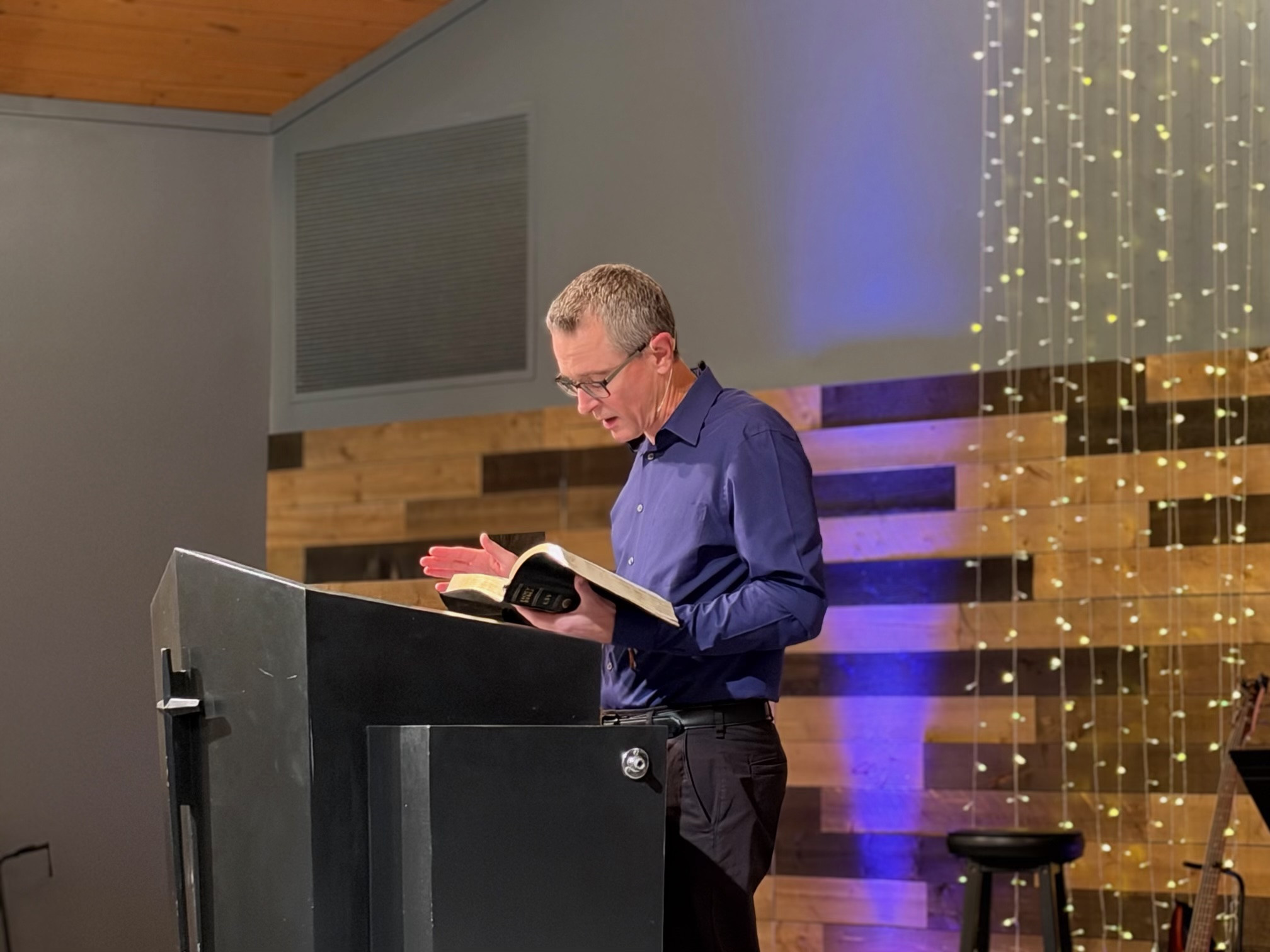
The following is a lightly edited transcript generated from the audio; it may contain small errors.
…for the fire hose, okay? I hope that you have some time. You know, we as sheep are really supposed to be cud chewers, right? We’re supposed to ruminate. And so, if we’re willing, He will give you some time to ruminate on some of these truths. And I pray that that’s really where… we sometimes fail to do that meditation and chewing-the-cud sort of thing. If you don’t know what that means, I’m not going to explain it to you. You’re eating. So, but that’s really where the nourishment takes place and that’s where things begin to take root and produce fruit. And so, hopefully you’ll get some time. That’s why we gave you the books. You can go back through and see some of these things and chew on them a little bit more.
So what we’ve tried to go so far is theology is what drives us to action. Specific theology, right? The theology from the Scriptures about who God is, about His nature and character, what His purpose is in the world. And in recognizing there’s theology that also drives us to specific actions and directs our actions, right? So we read in 2 Corinthians 4, the god of this world has blinded the eyes of the unbelievers. And it’s only opened through the proclamation of the gospel. God has shone in our hearts to give us the light of the gospel in the face of Jesus Christ, that’s what Paul says. So my ultimate point is this: it is not a missionary’s job to try to invent a new way to open blind eyes. God has given us the way to open blind eyes, and it’s the gospel. It’s the faithful proclamation of the gospel.
Okay, so one last theology that’s real important for us. Can we go to the next slide? Let’s talk a little bit about what the command of the Great Commission is. So the Great Commission is found where? Yeah, there’s actually lots of passages that I would accept as a correct answer, because it’s all over the Bible. Most of the time we talk about the Great Commission as Matthew chapter 28, verses 19 and 20. So if you’re there, let’s read that.
Go therefore and make disciples of all nations, baptizing them in the name of the Father and of the Son and of the Holy Spirit, teaching them to observe all that I have commanded you. And behold, I am with you always, to the end of the age.
(Matthew 28:19–20, ESV)
So one major verb in this, there’s really only one command verb there, and it’s make disciples. All these other things, this going, really the word go there’s a participle. So going, baptizing, teaching, those are verbs that aren’t the major command of the text, it’s make disciples. So what we believe about the Great Commission matters. So let’s talk a little bit about the state of the world. So nations, the idea of nations is, the Greek word is ethnē. And go make disciples of this, panta ta ethnē, all the nations, right? So what this means is sometimes we, in history, honestly, we’ve not always known. We’ve not made great guesses. Sometimes we think it’s country borders, right? And so we think if we get into the 196th or 208, or depending on who’s mad at who, where the countries are, they change all the time. We don’t have a set number of countries in the world because it’s always changing. So it’s not physical land borders. This idea of ethnē is where we come up with this understanding of what we would call people groups. Has anybody ever heard the term unreached people groups? Okay, great. Anybody never heard of it? You have to hear of it for the first time somewhere. Okay, so here’s what that means. We understand in Revelation 7 that God is redeeming a people from every tongue and nation. He cares about these ethnicities, these people groups, which is this term that means there’s a group of people that have the same language and culture so that they can communicate fairly well back and forth. They consider themselves as being the same type of people. I can preach pretty well in Oklahoma, not so sure about the St. Louis area yet. But, yeah. But I would be greatly concerned if somebody in San Francisco called me, right? Because I’m like, okay, I can’t be the hick that I am. Right? It would be a challenge. Because they’re different people. Right? They speak technically a very similar language. Their cultures are so different.
Right? So if you imagine we’re in the worship center—what do we call the sanctuary? Is there a fellowship hall here? Okay, there’s where? Did you say downstairs? Really? I didn’t know that. Didn’t know there were stairs. Now the people in the fellowship hall, if there are people, let’s pretend there are, they’re not actually hearing the service. They don’t know what’s going on. They’re not hearing the gospel. This is what a people group is. There’s a person that is in the room, but in order to get the gospel in the room, you have to have, you send it through a person. You understand, we don’t send missionaries because it’s fun. The only reason we send missionaries is because it’s through them that the truth of the gospel gets there. We have got to send them because they’re the ones that take the hope for the world. Now, the key to get in each individual room is language and culture. I can’t go get into the San Francisco room unless I learn a little bit about their language and culture. It changes if I have to go to Costa Rica. I’ve got to have language and culture for me to be able to take truth into the room. So what I want you to see is there’s barriers that are preventing the gospel from being passed from one people group to another people group. They’re an actual group, they’re in a room, the doors are shut and locked, and the language and culture has to be learned to be able to unlock it, to go in and assimilate some to this language and culture so that the gospel can be proclaimed.
So a reached people group is a group that—and it’s not always been the same. Back in the 70s, a man by the name of Ralph Winter came up with this idea of people groups, which makes perfect sense to me. I believe that’s accurate. He did it before I was born, so I can’t take credit for it though. But he taught this people-group idea. He made a guesstimation as to how many people groups were in the world; he was way off. I’ll show you how many people groups we now currently believe—we’re probably still way off. They change and are updated all the time. As people are, we go further into a group, a subset of people, and we realize inside the subset of people there’s actually another group inside it. And we’re also realizing that there’s times because of the globalization that other rooms are being absorbed into other people groups. That make sense? So these are changing quite a bit.
But here’s what I want you to see. A reached people group is what missiologists—I disagree with them, but it’s what missiologists would say—there’s somebody in that room with culture and language that can take the gospel and has convinced 2% of the people inside that room of the gospel. And so they say once 2% of the people, so if there’s 100 people in there, two people believe, then they say that’s a sufficient amount that we can call them reached. I don’t think that’s sufficient personally. But that’s the terms that you’ll get. And they used to, when it first started, it was actually 25% is what they wanted to call reached. Now here’s what’s happened. I want you to understand what a people group is, and I want you to understand what’s reached and unreached, but I do not want you to allow this to lead you to bad methodologies, which is what’s happened, unfortunately, to a lot of agencies. A lot of agencies are so absorbed with this unreached-people-group idea that they reject any other thing and they only want to go unreached. Now one, they fail if they just make a convert without making a mature disciple, right? Can’t we all agree to that? Mike and Justus have jobs here, right? There’s still work to be done as the body needs to be matured and the gospel must continue to go forth. Right? Okay, so we’re all on the same page.
People have got to this idea, and it’s often because of the misunderstanding of the part in Matthew where Jesus says, once everybody’s heard, then He’ll return. And so they’ve thought—that’s a poor understanding, that’s not what Christ was talking about, bad hermeneutic, okay? But they will look at it and say, we’ve just got to go and reach one person from every people group, and then Jesus will come back and we’ll finish the task. And that’s poor, poor missions methodology. So I want to show you why. First of all, some parachurch organizations throughout the years have actually changed the idea. They say that you can be a Christian and not be a disciple. There’s a disciple is actually like a second tier of Christianity where we actually obey Christ, and it’s not true, okay? In the Scriptures, there’s no distinguishing. A Christian is a disciple, a disciple is a Christian. You can be a really bad one, right? But it’s not like you have to follow these steps and memorize these verses and then you’re a disciple. That’s not it. A convert and a disciple are the same thing. Now what type of convert did Christ tell us to go for? So go and make them, right? So there’s your evangelism. But He keeps going. So evangelism is not the Great Commission. It is a part of the Great Commission. But you are not done. Okay, so go and make disciples, baptizing them in the name of the Father, Son, and Holy Spirit, which means there must be a church there. Baptism is an ordinance of the local church, and so there must be a church planted. And then they must, He says, teaching them to observe all things whatsoever I, Christ, has commanded you. There are some mission agencies that will say, they will go to a place, present the gospel, raise your hand if you want to be a Christian, great. And then they will say, now obey whatever Jesus tells you to do. It’s just the Bible, and they say, we check the box, we obey the Great Commission. I do not believe that Jesus said, telling them to observe what He’s commanded is actually teaching them to observe what He’s commanded. So we aim for maturity. So we have somebody in your church that is going to an unreached, last unengaged people group, which is awesome, right? But that does not mean that they’re a first or a better tier of missionaries than some of these other things that you have going on. The stuff that you can be doing in Belize is Great Commission ministry. But we’ve got to define these things really well for us as a foundational level so that we can make sure that we keep our methods proper all the way through. Make sense?
So the command is not to go tell all the people, and this has been a couple of months since I looked this up, but I think we’re at 7.9 billion, probably creeping closer to eight and we might have hit it. Feel like that’d be on the news. So there’s two aspects, or a couple of aspects to this. We want a church in every people group, and we want a Bible in every language. And so these are the things that are going to have to happen, because the church is, Christians are a people of a book. God has spoken, He’s revealed Himself to us through a book. So we must be book translators, His book translators, in order to help these brand new churches have Bibles. So the number of people groups in the world is 17,428. The number of unreached people groups, which means somebody might be in there trying to learn language and culture, but they’re still considered unreached because there’s less than 2% of them Christians. Unreached, unengaged, mean there’s not even anybody trying to make a key. Nobody’s trying to get in the room at all. Okay? So to explain this a little bit better, 86% of all Hindus, Muslims, and Buddhists will be born, live, and die without ever meeting a Christ-follower. Nobody’s even trying to make a key to get there, to get in that room. So let’s just stop for a second.
So many times we don’t understand this because we’re so close to where we are. And so sometimes it’s really helpful for us to kind of back up and get an actual bird’s-eye view of what’s going on in the world so that we can grasp some things. First of all, I want you to understand you are not living in a world that the task is almost completed. 7,415 of these people groups have not been reached. 4,977, nobody’s even attempting yet. We are not done.
Ralph Winter, great man, great missiologist. Same guy that did the ethnē understanding, helped us understand that. He also talked about having a wartime mentality. Wartime mentality means so many times we think that wartime mentality, when my grandparents served in World War II, and I remember their stories, such amazing stories that they got to share. But when our boys went to war, everybody went to war. You couldn’t get certain metals. Like, we had to start putting food in new things because everything was needed for the war effort. Here’s one thing I want to steer you clear from. The tendency of most people is that the missionaries are the ones that’s supposed to live in a wartime lifestyle. And that’s a failure. So many times we do that because we think we’re almost done. We think at any minute we’re going to get the gospel to the last place and we’re not even close. We’re not even close. Sometimes I think that because we think we’re so close, we’ll just sit here and we’ll let somebody else finish the last little bit. My encouragement to you is, as lovingly as I can: how do you look at that and you’re fine with your level of involvement in Great Commission ministries? I don’t think you can be. Okay, one fourth of the world’s population are unreached, over two billion people. This is the 10/40 window. You’ll hear a lot about the 10/40 window in missions. This is where the vast majority… this is where 96% of unreached people groups live. About 5.2 billion people. We have to learn a new language and a new culture to be able to go in to get to a new room, but you’ve got to be able to learn it so well that you can protect and proclaim the Scriptures, translate the Scriptures.
All right, let’s continue. So we are called to action. Matthew 28 calls us to action. This is a beautiful call. It’s a tremendous call, but it’s also a weighty call. And it’s one of those that I think we need to understand a little bit about what the task entails. It’s not as almost completed as we thought, probably. I think most of us probably showed up thinking we’re closer to finishing the task than we really are. And I hope that that spurs you to action. If you paint a wall, if you ever paint a wall with another person, if you’ll notice, once you get most of the way done, the other person will stop and will let you finish. Don’t be that person. Be the person that jumps in until it’s finished. So, maturity, multiplication, this is what we’re aiming for, not just converts.
All right, ecclesiology is one section that I’m going to skip for the most part because I’m going to cover so much of it later, but I want you to understand this. A poor ecclesiology, a poor understanding of what the church is, will never accomplish the Great Commission. You can never do it. For you as a church, as y’all’s churches, you have to have a biblical understanding of what is a local church so that we can go and accomplish it. We know that the church has to be planted in order for us to be able to say we can accomplish the Great Commission. So hopefully this is making sense, but these truths drive us to action and they direct our actions. Step number two, receive the mission. Don’t choose it, okay? Receive the mission. This is really simple. Christ is the head of the church. He gives the mission to the church. The church’s job is not to say, hey, what should we do? The church’s job is to receive what Christ has told us we should do, and then go do it, okay? Colossians chapter 1, 9 through 20:
And so, from the day we heard, we have not ceased to pray for you, asking that you may be filled with the knowledge of his will in all spiritual wisdom and understanding, so as to walk in a manner worthy of the Lord, fully pleasing to him: bearing fruit in every good work and increasing in the knowledge of God; being strengthened with all power, according to his glorious might, for all endurance and patience with joy; giving thanks to the Father, who has qualified you to share in the inheritance of the saints in light. He has delivered us from the domain of darkness and transferred us to the kingdom of his beloved Son, in whom we have redemption, the forgiveness of sins.
He is the image of the invisible God, the firstborn of all creation. For by him all things were created, in heaven and on earth, visible and invisible, whether thrones or dominions or rulers or authorities—all things were created through him and for him. And he is before all things, and in him all things hold together. And he is the head of the body, the church.
(Colossians 1:9–18, ESV)
Where do I get this idea? The Bible. I believe it. It’s that conviction to go forward. He’s the beginning, the firstborn from the dead, that in everything He might be preeminent. If we would only believe this verse. So many churches are set up where Christ isn’t forefront at all. We just want to give our people someplace fun to come to. We want to be seeker-friendly, so we just want to let everybody know God loves them. It’s all about them. Guess if I like that. Oh, Christ should be preeminent. And through, for in Him all the fullness of God was pleased to dwell. This is why we exist. This is why God has us here, because we want to glorify His great name through obeying what He has given us to do. And so we should collectively join together to worship Him, sure, but also collectively join together to acknowledge we have a purpose together.
We can scarcely set up a claim to be regarded as a true branch of the Church of Christ or take an honorable place in the sisterhood of evangelical churches unless we keep this object constantly and distinctively before our minds. So at this point I think it’s probably helpful to distinguish between mission and missions. This has sometimes caused some confusion. There is a mission of the church. The mission of the church is making disciples. But there’s more than just one aspect to it, okay? So as He’s called to do this, obviously if converts were the goal, the church would be unnecessary. Because you can go and make a convert without planting a church. But the church has to be there because converts are not the goal. Well-trained, mature disciples who can multiply and continue the mission is the goal. So in order to do this, in order to make disciples, your church exists and it has to love. It’s got to care for souls. It’s got to provide instruction. It’s got to provide encouragement to righteous living. All these things have to happen. So inside the church, you’ve really got a couple aspects. You’ve got the Great Commission and you’ve got the Great Commandment. So what happens is missions is the Great Commission going forth and creating what we would call a gospel community, which will live out the Great Commandment. You all remember what the Great Commandment is? Yeah, love the Lord your God with all your heart, soul, mind, and strength, and love thy neighbor as yourself. So those things have to happen. So the Great Commission, missions, is going to a place that that’s not happening to create a new gospel community so that the Great Commandment can happen. And then from this, we also take missions as going out to do it again. So the mission of the church is all the things that the church is required to do here.
So there’s a couple of aspects. There’s generational ministry. So whenever I go to a church, I never really care about who’s going to disciple me. I care deeply about who’s going to disciple my grandkids. Anybody ever think about who’s going to disciple your grandkids? You should think about it. I hope that Liberty Church is here in 80 years, continuing this task. Because we must generationally continue to pass this truth on. There’s also a geographic aspect, right? So first of all, we want this to kind of be a beachhead. We have taken the hill. We’ve taken Liberty. O’Fallon, Missouri, that’s where we are, right? So we want to set this up and keep it. We don’t want the enemy to push us back. We don’t want to retreat from what we’ve accomplished. The gospel has made it to here and it needs to stay. And so that’s a geographic thing. But also we look around and we go, well, the gospel is not over there. I don’t know what the next town is, but it’s not there. There’s communities in O’Fallon… How do we get to those people? Right? So, generationally and geographically. The mission of the church is all the things that are here, and it includes missions, which is getting it out of here to a new place, to new people. Does that make sense?
So, Kevin DeYoung and Greg Gilbert got together and wrote a tremendous book. But they say missions is not everything the church does, but rather describes everything the church has sent into the world to do. So really this is one of the things DTN says quite a bit, that the church is the means and the goal of missions. It’s how missions is accomplished, but it’s also the goal of what we’re trying to accomplish. Here’s what I mean. What is happening here? You guys have joined together. You’ve worshiped the Lord together. We’ve prayed together. You’ve studied the Scriptures together. You observe the ordinances. You proclaim the truth. You have biblical church eldership. You hopefully are doing discipline and encouragement and all these things, right? What is happening here is what I want to happen for those 86% of Hindus, Muslims, and Buddhists. I want this to be there. Right. So it’s the means. How is it going to happen if you don’t do it? It won’t. We must come out from our beachhead and go take more ground. We got to take the gospel to new places and then create the very same thing that’s happening here. We want to happen with all these, with every 17,400 and whatever other people groups. Right? Don’t you long for that day when Revelation 7 happens, every tribe, tongue, and nation are there rejoicing together, proclaiming, we are redeemed people because You are a redeeming God. And how did He do it? The only way is through the church.
So receive the mission, recognize that Christ has given us the mission. So, these are things that I don’t have time to do with, but I put some stuff, I pray that you guys can have some group sessions, and I’m happy to come back and help walk you through kind of workshops and things, but I’ve put some questions in some of these sections that I want you to read and think about. What cross-cultural opportunities exist in close proximity to your congregation? Because of globalization, the great thing is there’s unreached people groups right here around you. And maybe there are unreached people groups or there’s just unreached peoples in your group. There’s more people that look and talk like you that need to be in here too. So ultimately you need to have a church mission, the mission of the church. Now it needs to say something to the effect of, we as a church exist to exalt the Lord by evangelizing unbelievers and edifying and equipping disciples to maturity and multiplication from here to the ends of the earth. You can use that one if you want to. Typically, pastors are really creative and they come up with really good stuff. But it needs to say something like that. Because God said that’s what it should say. Why? Right? You’re here to exalt the Lord, to evangelize unbelievers, to edify and equip believers to maturity and to multiplication from here to the ends of the earth. That’s what the mission of the church is. I’m right. You don’t like it, but I’m right. So the question, of course, is what’s the mission of your church? This is where I want you to walk through and have you at this point collectively say, Lord… and I don’t know your church, okay? So don’t take this like I’m not… truth only hurts if it ought to, okay? I don’t know. If you’ve not been obeying this, then this may sting. But if you have, then it won’t. But collectively, you as your church should be able to be in agreement that this is our mission. Amen or ouch? I can’t really tell. He’s giving me not a lot of feedback.
So this may help you, okay? So not only is it important to talk about what is the mission of the church, I think it’s helpful to talk about what is not missions. We need to feed the hungry. Is that something God calls us to do? Sure. That’s a mission of the church, but it’s not missions. Okay. Now, understand what happens. Gospel comes first. Okay? Missions, when you’re going to a new area, gospel comes first. But there’s what we in the missions world will call rice Christians. You can create a lot of rice Christians if you show up and feed people, you will have people that want to be Christians like crazy. In Malawi especially, they are growing the Muslim faith tremendously because they started to come up to these villages and just feed these villagers, and since they’re hungry they’ll be whatever, whoever has the rice is. Here’s my point. There’s far greater suffering that we should care about than somebody being hungry. There’s an eternal suffering. It’s far worse. It’s far worse. Now, I understand there’s the old Haitian proverb that says a hungry stomach has no ears. I grasp that there are times that we have to help physical needs. I want you to hear me well on that. But you have to grasp that if you fed their stomach, you’ve not actually alleviated any of the major problems. But the other side of that same coin is this, there’s far greater joy and pleasure to be had than just a full stomach. The joy of the gospel, the joy of redemption, the joy of knowing the Lord, these things are far greater, far more important. Aid divorced from the context of faith fails to deal with humanity’s most basic problem. Our mission requires a move of the Spirit. We can’t open blind eyes by ourselves. I love Acts 26 where God calls Paul to do things that Paul can’t do. Acts 26, Paul is giving the outline of his experience on the road to Damascus, and he’s recounting what Christ told him. Let’s go to Acts 26. I’ll just show you. I got the 2 Corinthians 4 passage in my head, now I can’t remember it. There it is. Verse 17:
…delivering you from your people and from the Gentiles—to whom I am sending you to open their eyes, so that they may turn from darkness to light and from the power of Satan to God, that they may receive forgiveness of sins and a place among those who are sanctified by faith in me.
(Acts 26:17–18, ESV)
So get this, Christ is telling Paul to do this. Which of these things can Paul do? Can Paul open their eyes? No. Can he turn them from darkness to light? Can he turn them from the power of Satan to God? That should be a stronger no. There should be a convictional no there, right? That they may receive forgiveness of sins and a place… no, he can’t do any of those things. This is crazy. If I was Paul, I’d be going like, now how do you expect me to do that? I can’t do any of those things. And then we understand, Christ says, I am sending you, I’m going to do the work. The mission of the church requires a move of the Spirit of God. The Spirit of God is the one that has to open up their eyes. The Spirit of God is the one that turns them from darkness into light, from the power of Satan to God, that gives them the forgiveness of sins. It is the Spirit of God that does that. So is it a mission of the church or not? It’s really easy to tell. Does it require a move of the Spirit? Okay. But does feeding them? No. No, it doesn’t. Missions to get the gospel there, to reach somebody for conversion, it takes a move of the Spirit. So an easy way to tell whether or not this is the mission of the church is, does it require a move of the Spirit? If the answer is yes, then yeah. Another way that might be helpful is if Bill Gates will donate to it, it’s not. It’s not. That’s true. I love you enough to tell you, the world hates missions. They don’t want you to go and tell people that they’re not good with God. They won’t give money to that. If lots of secular people want to give to your ministries, I want to question whether or not you’re doing what you’re supposed to do. Is that okay? Do I need to rein that back a little bit? I’m getting some mean faces. I love you enough to tell you. It requires a move of the Spirit.
Now, missions includes relief. I don’t want you to say, I don’t want you to believe it doesn’t. I just want you to understand that the church should happen first. Preferably, all relief work will happen from the local church. If O’Fallon gets hit by some sort of disaster, I hope it’s your church that’s reaching them, that’s caring for them, that from the local church, the love of Christ is being poured out, because then it’s, because of the gospel, then it’s proper. You don’t go in and start… I mean, this could have been something Jesus did, right? He could have went and started a healing shop if it was only about doing relief work. And He’d have stayed plenty busy. But that wasn’t His mission. His mission was to proclaim the kingdom. Okay, that’s what our mission is. Without God being at the center blazing like the sun, missions becomes a hollow, man-centered, striving for social good. And that mission does not save. Temporary relief of human suffering will not save from eternal condemnation. And I tell you this, and DTN helped about 20,000 Ukrainian refugees this last year, right? We did all of it through one local church, every bit of it. It was glorious. The local church has more than doubled in size. Conversions, baptisms, people coming to the Lord—it’s been glorious. It’s been incredible what the Lord has done through an absolutely tragic situation, but the Lord often works through those situations. And so it’s really sad when there is those tragic situations and the church says, let just some relief people do it. What an opportunity for us to get out of here and take it to new people, right? So I’m not anti doing that type of work, but I’m anti doing that type of work in a bad way.
Step number three, should be able to finish this one. Beware of mission drift. I say this just because I love you. Okay, this is a problem. God does not change and His mission does not change either. So we must guard it. God’s mission to us needs to be our North Star. You guys know how sailors used to have to know where the North Star was to get them the proper way. We’ve got to keep it as our North Star or else we will easily veer off the path. Unfortunately, there’s a book called Mission Drift, I highly recommend it. But in it he says, the natural course of many originally Christ-centered missions is to drift. Few willingly, consciously change directions. It’s very rare that that happens. We’re doing this, but hey, let’s change it and let’s do something else. But it happens quietly, gradually, and slowly. So I want you to know this because if you’re at this stage of we want to develop what our mission strategy is so that we can do this, you need to immediately be thinking about how do we keep this the strategy, because our enemy hates a biblical strategy for missions and he will do everything he can to make you veer off that path. Sometimes it happens because there’s a lack of structure in an organization or in a church, or it allows too many people to create and or steer. There was a Christian university started several years ago, and their mission was this: “Let every student be plainly instructed and earnestly pressed to consider well the main end of his life and studies is to know God and Jesus Christ, which is eternal life, and therefore to lay Christ in the bottom as the only foundation of all sound knowledge and learning.” Do I know what university that was? Harvard. Would any of us today consider Harvard a Christian university? No. So, there was a group of people, when Harvard left their mission, there was a group of godly men said they were going to start a new school that would stick with a Christian mission, that we now call Yale. And they have drifted as well. And so we have got to guard against our own personal agenda from becoming more important than God’s agenda.
So let me show you some scriptural examples of this, and these aren’t fun. Let’s talk about the church at Ephesus real quick. The church at Ephesus was planted somewhere around 52 to 56 A.D. We learned a lot about it in Acts 19 and 20. Paul was there. Paul spent a couple of years in Ephesus. Scripture says that the gospel went forth in an incredible way, that everybody in Asia actually heard the Scriptures. He labored so well that Paul towards the end of his ministry actually told the church this. He said, your blood is not on my hands because I have not shrunk back from faithfully declaring to you the whole counsel of God. That’s one day, if the Lord… that should be Mike’s last sermon. That’s the goal, right? Is to so faithfully do what you’re called to do that when the Lord’s done with you in a place you can say, the blood’s not on my hands. I’ve done everything I was supposed to do. Paul then goes on this great discourse about here’s the… Joshua says, choose this day whom you will serve, whether the gods your fathers served in the region beyond the river, or the gods of the Amorites in whose land you dwell. But as for me and my house, we will serve the Lord. And then there arose another generation after them who did not know the Lord or the work that He had done for Israel. And the people of Israel did what was evil in the sight of the Lord and served the Baals, and they abandoned the Lord. The natural tendency of the mission is to drift. It will happen. So immediately we have to begin to think about not only is this the mission we will believe and cling to, but this is the mission that we will pass on. That is such a sad thing. Joshua dies, but his grandchildren did not know the Lord, nor the work that He had done for Israel. That’s tragic.
This is why Jesus says, work, for the night is coming when no man can work. We are interim pastors, we’re relay racers. If we’re going to make sure that this mission does not fall short somewhere, we’ve got to make sure we pass that baton. We are relay racers, we’re interim leaders, interim stewards of the mission of God, but we must make sure part of our stewardship is to make sure this next guy gets it, and can make sure the next guy gets it, right? I say it again, this is not to bash churches, but I’ve seen far too many, and we can look at whole denominations that at some point were good and godly, and now they’re not worth anything. We can see it happen. How do we stop it? We’ve got to pass it on. We’ve got to make sure. And one of the ways I want to encourage you to do it is to recognize that you need to be scaffolding. The way most ministries are set up, and this is the way we teach our missionaries. So many missionaries go and they’re sent forth as circus tent poles. You guys ever seen a circus tent? They put one giant pole in the middle and everything comes up. And it’s incredible if you actually get a chance to see one come down because it’s like that, right? The pole comes out and it’s gone, right? And so many people build their ministry like that. Everything is around me. I do it all, I do this, I do that. All these people are here because of what I do, which is the only problem is that’s not the Bible, right? But ministries will crumble as soon as that person is removed, as God calls them somewhere else, or calls them home, it’s done. That’s a terrible idea. We need to be scaffolding. We’re there and we can build it, but once it’s built, scaffolding can be removed and nobody even remembers it’s there. That’s my job, I’m an interim guy. I’m doing my very best to encourage others, to train others up so that this can continue. Make sense?
Okay, so just a statement of fact. It’s not a witch hunt. Lord willing, if the Lord allows, I’ll be able to come back in five years, and I’ll be like, who are all these new people? Who are these new people that are so interested in missions? Where’d you learn about… man, these people have been telling us, been teaching us, and it’s just such our culture now. I’ve taught this at a church that I’ve been ministering with about eight years, I guess. And this is what I told them. I said, why are you the same people that were here eight years ago? That’s a problem. If there’s nobody new, if you’re still the only people in this church that care about missions, that’s a problem, isn’t it? We want others to do this. We want youth to do this. We got to pass this on. This has to be something that is in every program in our church because this is our culture, this is who we are, this is our mission, and it’s not just the mission of these people, it’s the mission of all of us. The second law of thermodynamics says the natural tendency of an isolated system is to degenerate. Cooling is inevitable. And so we must do what it takes to keep it warm.
My apologies, I’m not going to make it through Start Well. I will try to finish it up early tomorrow. There’s just some of these things that I really felt the need to, I didn’t want to cut out. Because this is that foundation that, we can work on some of that practicality stuff tomorrow and it’ll make a lot more sense as long as this foundation is solid, okay? Questions, comments, fears or frustrations, anything you’ve got. You’re actually welcome to talk. Yeah. You mentioned Ralph Winter. That program that they do, those classes, are you familiar with that? Is that a program you’d recommend? It’s a pretty good introduction. There’s several things in there that I would disagree with. Maybe with some of the foundation you’ve got today, you could take it and go, eh. Because they do push some of the, they’re heavy on the unreached people groups, right? And so they fail to understand… well, okay. So the first evangelical missionary made it to Honduras in the 1760s. Still to this day, over 80% of all Honduran pastors have never had any theological training. We spend billions with a B, okay? Billions every year annually to send short-term teams down there, and we’re not investing in those local people. We’re not making mature disciples. If we would have done our job, Honduras would be doing their own thing right now. You see, the goal of missions, when we know that we’re done, right, DTN, we’re done when the mission field becomes the mission force. Okay? When the field is mature enough and multiplying enough that they can not only reach their own, but they can learn how to launch others out into new places. When they can have that generational impact and that geographical impact. Does that make sense? So we invest and serve and minister in a way so that they can become the force, not so that they forever become the field. We’ve made a mistake in how we do Honduras. I would love to stop that. I can come up with lots of better uses for a billion dollars. So it’s that theology that’s not there that doesn’t direct our actions. If we direct our actions the right way, that field should be the force that’s helping us reach the rest. Make sense? Okay, sorry. I take one little thing that I’m supposed to answer and then just run sometimes. My wife always says, that’s not what they asked. Shut up. Okay. I’m here. I’ll hang out for a little bit if anybody has questions. I pray that you can come back tomorrow. Tomorrow gets far more practical. I do a lot less yelling at you tomorrow. Okay? But thanks for putting up with it. Is it okay if I pray with you?
Father, I’m grateful for these, Your people. It is good to be in Your house, good to be amongst believers, brothers and sisters, Lord, who I believe are willingly and joyfully placing themselves under the authority of Your Word. Lord, to learn of who You are and of what You would require of us. And God, I pray that You would build conviction in their hearts, that we would so believe the truth of the gospel that it would change us and it would change what we do. That we would willingly embrace Your call to missions. And we haven’t really got a chance to talk about what that means to either go or send or what that means, but Lord, I pray that mainly for tonight that You will have awakened us from a stupor, of maybe thinking that we didn’t really have much to do, maybe thinking that we were fine with the tactics that we had been using. Lord, that You would get us engaged, engaged in praying and encouraging and serving and sending, and Lord, even being willing to go, if that’d be Your will. Lord, I’m thankful for these people and I pray that You take Your Word and You give it root, and Lord that You use it to produce fruit for Your glory for many years. I ask that You bless them, give them a good night’s rest, and Lord for those that can, I pray that You would bring them back safely and that You would give us a day tomorrow where we can continue to learn and continue to be impacted by the truth of Your Word. We’re good, and God I acknowledge we are in desperate need of You, desperate need to accomplish this. We can’t do this alone, and God I just want to rejoice in the fact that when You gave us the commission You gave us a great promise: lo, You are with us always, even to the end of the age. And I’m thankful that we never have to walk without You. Bless these people, I ask this in Christ’s name, amen.