
July 26, 2026
Whose House?
Dr. Michael A. Bond · Joshua 24:14–18
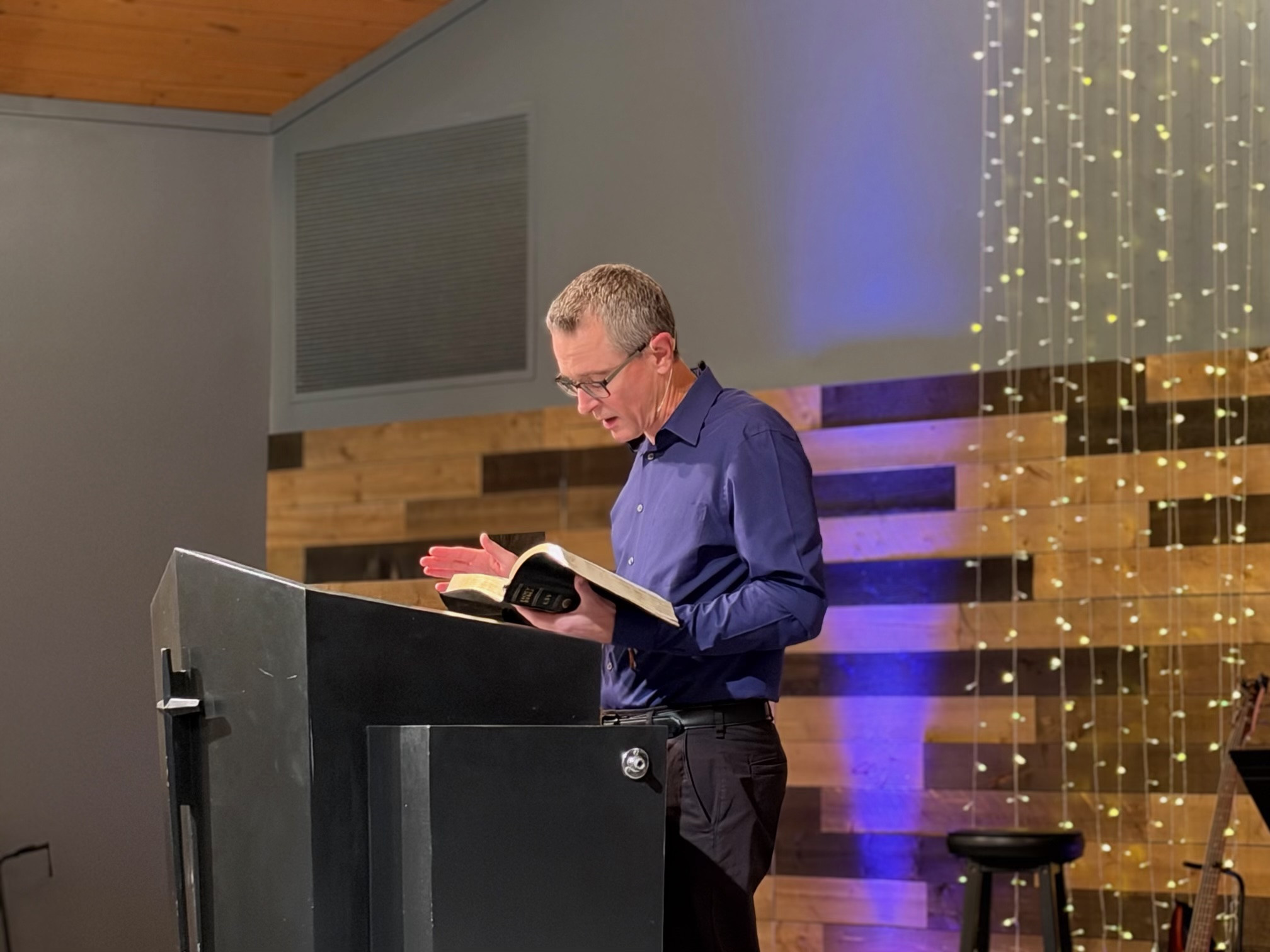
Joshua 24:14-18
The following is a lightly edited transcript generated from the audio; it may contain small errors.
Joshua 24. We’re starting in verse 14.
Now therefore fear the Lord and serve him in sincerity and in faithfulness. Put away the gods that your fathers served beyond the River and in Egypt, and serve the Lord. And if it is evil in your eyes to serve the Lord, choose this day whom you will serve, whether the gods your fathers served in the region beyond the River, or the gods of the Amorites in whose land you dwell. But as for me and my house, we will serve the Lord.
(Joshua 24:14–15)
Let’s pray. Father, we do thank you for this day. It’s a day of celebrations, as we’re adding new members, as parents are dedicating their children to you, as people are publicly proclaiming their faith in you through baptism. So we do rejoice, Father. We thank you that you’re here in our midst, that we can lift up our voices and sing your praises, that you are a good, good Father. Thank you that you are here with us now. We pray that you would continue on to bless the preaching of your word. Let us receive it as it is your word. Help us to hear from you today, and may you be blessed in our presence. Amen.
Well, this is Joshua speaking here, and this is really the end of Joshua’s life. So if you don’t know the story, the Israelites are in bondage for hundreds of years in Egypt. Moses ends up taking them out and leading them out by God’s grace and mercy. And then they’re getting ready to enter the Promised Land, a Promised Land that had been promised hundreds and hundreds of years earlier to Abraham. But what happens? Do they enter it right away? No. So what do they do? Well, they’re coming up to the edge of the Promised Land and they send 12 spies into the land to check it out, right, and those 12 spies come back and what kind of report do they give? Well, there’s two different reports that they give, right? Ten of them, ten of the 12, give this horrible, awful report, and there are giants there, and we’re going to get slaughtered, and we just can’t do it. And they get the nation of Israel to be like, yeah, we can’t do it. They’re whining and moaning and complaining. So God’s like, fine, your discipline is to wander in the wilderness for 40 years. And of all those adults that were part of that decision, if you will, only two get to enter the Promised Land. Who are they? Joshua and Caleb, the two faithful spies. Not even Moses gets to enter.
So this is really after Moses dies. You start with Joshua chapter 1, that’s actually how it starts, and the mantle’s been placed on Joshua, basically. He’s the new leader. He’s taken over from Moses. And now the 40 years have passed. So what did they do? Well, they go in and they take the land. They take what God has promised them, the Promised Land. But here we’re getting all the way to the very last chapter of Joshua. So all this time has passed. They’ve conquered the land, it’s been divided up. God’s been super gracious to them and blessed them physically, spiritually, all those things. Then this is kind of his end-of-his-life, so to speak, exhortation. “As for me and my house”—he’s like, you guys decide who you’re going to serve. But as for me and my house, we’re going to serve the Lord.
Let me just make a couple of applications. [audio unclear] cities, and it wasn’t going to be an easy task. It was a monumental task. But monumental tasks—teach your kids that monumental tasks that only can be achieved by God are possible. That you can do it if God tells you to do it. Is it going to be easy? No. Is it going to be challenging? Absolutely. But can you do it? Yes. Tough and challenging things await your children. They just do. Has anyone that’s above the age of 20 not had tough and challenging things that they’ve gone through, right? So you can either like wrap them in bubble wrap and keep them in a bubble and think that the world is just perfect and all peachy and roses, or you can teach them about reality and, at the proper time, show them some of those things, give exposure at the proper time. [audio unclear] amazing things. So that’s the first thing.
Second, simply teach them to follow God’s commands. Think about that for a minute. The command was to enter the Promised Land and take it. What would it look like if they were to listen to the two spies and not the ten? Well, you say, well, why should they have done that? Because God told them to take the land. God commands it, we obey. God commands it, we obey. That’s like the simple truth of Scripture. God commands it, we obey. So God told them to take the land. That’s what they should have done. Train your kids when they’re young: follow God’s commands, right? Sometimes some people use the term like first-time obedience. They get commanded it, they obey right away. They get commanded it, they obey right away. Did eventually the Israelites obey? Yeah, 40 years later. They even tried to obey initially.
Additionally, three, train them to not let the loud majority sway them. Ten spies, but all it took was 10 to sway the masses. All it took was 10, and 40 years in the wilderness suffering. Just 10, and it turned everyone against Moses. So train them not to be swayed. It would have been so easy for Joshua and Caleb. I’m sure as they’re traveling back from the Promised Land with the other 10 spies, they realize what’s about to happen. It would have been really easy for Caleb and Joshua to go like, okay, yeah, like this probably isn’t going to go too well for us. Maybe we should just go along. No. They stood their ground. Literally ended up standing their ground against millions. What did the Lord do? He rewarded them for their faithfulness. God always rewards faithfulness and obedience.
Additionally, teach them to trust him despite all the obstacles. There are going to be obstacles put in our paths, and we have to decide whether we’re going to keep following Jesus. Obstacle after obstacle, challenge after challenge, temptation after temptation, trial after trial. Teach them to choose—Jesus calls it—the narrow path. Why? Wide is the path that leads to destruction. Narrow is the path that leads to life. What did Jesus say? And few choose it. So choose the narrow path.
And then finally, teach them that God uses the ordinary to do the extraordinary. I mean, that’s like—you just look through the Bible and that’s what you see. [audio unclear] You can do it because I will empower you to do it. So teach them that God uses the ordinary to do the extraordinary. He uses a few fish and loaves, right, to do the miracles. He uses some ragtag group of men to be apostles. They weren’t anything special. That is, before God got to them and changed them.
And part of the training entails showing them who God is and the design that he has set forth for this world. In other words, show them God’s created order. God has a created order. I mean, he created everything, right? Amen? So we find out he has a created order for all of creation. Time doesn’t permit, but you can read it on your own. There is order. There is order as he’s creating things. It’s not just like randomness or chaos; there’s order. And then we get to the very beginning of Genesis 2. It says,
Thus the heavens and the earth were finished, and all the host of them. And on the seventh day God finished his work that he had done, and he rested on the seventh day from all his work that he had done. So God blessed the seventh day and made it holy, because on it God rested from all his work that he had done in creation.
(Genesis 2:1–3)
So, I mean, every seven days, what do we see? Rest, worship. Every seven days, rest, worship. Every seven days, rest, worship. That’s the pattern that was set out from the beginning of time. Seven days in and he’s like, here’s what we’re doing: rest, worship. So listen, God wants his created order to be followed. He has a created order for the home. Amen. He has a created order for the church. Amen. He has a created order for civil government. Amen. So train your children as to what the created order in the home is. Like, he’s created it. We’re just following the blueprint, if you will. There’s a blueprint. He’s created it. He’s told us what it is, so we follow it. He has a blueprint for the church. I mean, he created the church. There’s the blueprint, so we follow it. Same with civil government. Train your children what the created order for the civil government is. There’s a created order. And what does he want? He wants his created order to be followed. He has not left us clueless to try to figure this out on our own, not in any of those three spheres. He’s laid it out very clearly. And here’s the thing: guess what happens when you follow the created order? Guess what happens? Good things. Good things happen. Good things happen. Entire civilizations have been built because they looked to God and his word for what the created order was, including ours. So good things happen. The Lord blesses us when we set up the family, the church, and society the way he sees fit and not the way we see fit.
Did you know if you just live by the book of Proverbs—the Proverbs are just like short, pithy, truthful statements about all sorts of different things—but if you just live by the book of Proverbs, you’d do really well. Because God’s basically like, here’s factual information about the created order. Even if you were an unbeliever and you just followed the book of Proverbs, you’d actually do pretty well in life. Now, on the day of judgment if you’re an unbeliever, that’s a different story, you’re going to be in a world of hurt. But if you follow God’s created order, generally things go well for you. So God has an order to his universe. I mean, imagine how scary it would be if nothing was certain about the created order. You wake up tomorrow morning and gravity is five times as strong as it normally is. You can barely get out of bed. Then the next day you wake up and it’s one-fifth of what it normally is. You take that first step and you’re hitting your head on the ceiling. I mean, God has design, intentionality. He has order to the universe. He wants us to follow that order.
What happens if we don’t? Well, the Bible says that if we don’t, we’re basically mocking God. Galatians says,
Do not be deceived: God is not mocked, for whatever one sows, that will he also reap.
(Galatians 6:7)
So we can mock God in regards to the creation. As one theologian said, you can’t mock God and his created order by putting lipstick on a bull and calling it a cow. Well, why is this? Because God is not mocked. I remember back in college, I don’t know if they have this anymore, but we had like little white boards on our doors and you could leave messages for people. Now you probably just text people and you don’t even bother going to their room if they’re not there, right? We didn’t know that back in the day. We didn’t have cell phones. So I remember one of the guys on my floor, Big Dave, and Dave was big, okay? Probably the biggest guy I’ve ever met, and I’m not talking strong, I’m just talking big. And everyone called him Big Dave and he was good with that. Super, super nice guy, by the way. Super, super nice, wouldn’t harm a flea. But Dave left some kind of crass little message on my whiteboard about Jesus. And I wasn’t too happy about that. So I just wrote Galatians 6:7. I didn’t even write out the verse, I just put Galatians 6:7. I said, “Dave, Galatians 6:7.” I knew he’d figure out a way to look it up. He didn’t have a phone back then, right? And he came by later, he’s like, you’re basically saying I’m mocking God. I’m like, yeah, you are. That’s what you’re doing. I still pray for Dave.
Well, why is that? What happens when we mock God in his created order? What happens when we mock God in the home? What happens when we mock God in the church? What happens when we mock him in the state? Will God honor a nation that mocks him? I mean, serious question. Why would we expect the blessings of God on this nation if we as a nation continue to mock him? God will not be mocked. So it says we’re sowing. “Whatever one sows, that will he also reap.” So the question for us is, individually, like what are we sowing? What are we sowing in our own hearts? What are we sowing in our kids’ hearts? What are we sowing at church, in the home? What are we sowing in the state, the civil realm? Because it goes on, verse 8: “For the one who sows to his own flesh will from the flesh reap corruption, but the one who sows to the Spirit will from the Spirit reap eternal life.” So God wants us to act in accordance with his created order. There’s a simple created-order truth. It’s back to the Proverbs. You reap what you sow. That’s what it says right here. You see that actually a few times throughout the Bible. You reap what you sow.
And listen, we’ve been kind of sold a bill of goods. Some might say a bill of lies; it’s the same thing. But we’ve been sold a bill of goods regarding religious freedom. True religious freedom, listen to me, true religious freedom. I mean, Joshua is hitting on it right there in verse 15 of chapter 24. What does he say? “Choose this day whom you will serve, whether the gods your fathers served in the region beyond the River, or the gods of the Amorites in whose land you dwell. But as for me and my house, we will serve the Lord.” I mean, so you’ve got options. But when we talk about true religious freedom, we’ve kind of been sold a bill of goods, because true religious freedom isn’t worshiping anything and everything under the sun, including the sun, the moon, and the stars. That’s not religious freedom. Listen, friends, that’s bondage. That’s bondage to false gods and demons. The created order isn’t to be worshiped. You worship the created order, you’re mocking God. So the Creator of the created order is to be worshiped. The Creator. And there’s only one. And his name is Yahweh. That’s the Hebrew. We usually just refer to him as God, or we can call him our heavenly Father. But the created order isn’t to be worshiped. False gods aren’t to be worshiped. So true religious freedom is being freed from sin and bondage. That’s the true religious freedom, and being able to worship the one true God and his Son, Jesus. Earlier in Galatians, what does Paul say in chapter 5?
For freedom Christ has set us free.
(Galatians 5:1)
What does he say? It was for freedom that Christ set you free—to worship whoever you want and wherever you want? No. It was for freedom that Christ set you free to serve him. That’s religious freedom: to serve the one true God and his Son, Jesus.
Now think about this, and Joshua here, he says this interesting term. You probably saw it and read it a thousand times, but have you ever thought much about it when he says, “As for me and my house, we will serve the Lord”? [audio unclear] We don’t really know much about his father, but it appears that he did a great job training his son. Because all those things I’ve encouraged the parents already in my message, it looks like he [audio unclear]. We remember Joshua and Caleb, and really their dads. How can Joshua say, “As for me and my house”? How can he say that? Because he’s the head. He’s the leader. He can speak for them. [audio unclear]
What’s the primary reason to worship the Lord? Yes, somebody’s like, I can do that at home. Well, sure, you can, but you’re commanded to come together and worship him together. I mean, we just saw it in Genesis: that is literally the pattern set up on day seven. God’s like, rest and worship, rest and worship. For the history of mankind, thousands and thousands of years, the pattern has been set: one day aside and come worship me corporately. That’s the pattern. But think about this: when church is optional, you’re teaching your kids something. You’re always teaching your kids something. But when church is optional, you’re teaching your kids something. Why were we created? We’re created to worship him and enjoy him. We’re leaving out the essential part of why we’re created if we just skip out on church whenever we just kind of feel like it. We’re teaching them God is optional. We’re teaching them to worship, but God is optional. No. That’s the reason they were created, and we need weekly, weekly, weekly to worship our great God. That’s been the history of what God set up a long time ago.
Same thing, just to be honest with you: when kids’ sports or other activities are always the priority over going to church, I’m just telling you, you’re teaching your kids. So you younger parents, they can’t even walk yet, or they’re barely walking, you’ve got to make some decisions. What is it you’re going to teach them? Because if those sports are always trumping it, and you’re skipping church—they’ve got some soccer game, some activity—what are you teaching them? The soccer game is more important. And that’s what you’re teaching them. Now you might not ever say that, but you show it. I know that’s not the message you want to send, but it’s the message you do send. So don’t send it. If you want God to be number one in their lives, you have to live like God is number one in your life. All right? If you want God to be number one in their lives, you have to live like God is number one in your life.
And God is very gracious. We get some amazing promises. Just turn. We’re just going to look at one briefly in Acts chapter 2. Peter stands up on the day of Pentecost in Acts chapter 2, and he really gives like the first sermon. And here’s how he concludes it. In verse 36, chapter 2 of Acts:
Let all the house of Israel therefore know for certain that God has made him both Lord and Christ, this Jesus whom you crucified.
(Acts 2:36)
Well, that’s not very kind of you to say, Peter. That’s not very seeker-sensitive. No, they needed the hard truth. They needed the hard truth. And a lot of times, so do we. And look what happens because he’s willing to share the hard truth. Now, verse 37:
Now when they heard this they were cut to the heart, and said to Peter and the rest of the apostles, “Brothers, what shall we do?” And Peter said to them, “Repent and be baptized every one of you in the name of Jesus Christ for the forgiveness of your sins, and you will receive the gift of the Holy Spirit. For the promise is for you and for your children and for all who are far off, everyone whom the Lord our God calls to himself.”
(Acts 2:37–39)
Well, look at this word that he says in verse 39 at the very beginning. “The promise.” The promise is for you. What’s the promise? Well, it’s that if you repent and believe, you receive eternal life. That’s the promise. Like, God promises, hey, if you repent and believe, you’re cut to the heart just like these people. You repent and believe, forgiveness of your sins, and eternity with your heavenly Father. That’s the promise. Well, what’s that visible sign? Why the command to be baptized? Because that’s the visible sign of entrance into the church. Some people call it a sign, some people call it a symbol. That’s fine. But baptism is the visible sign of entrance into the church. Now what’s the visible sign that you’re staying in the church? All right, y’all need to go to Sunday school next week, all right, or you need to come back here. It’s the Lord’s Supper. That shows that you’re continuing in the fellowship with the Lord. Now, before you sit at someone’s dinner table, you knock on the door and enter the house, right? True? Okay, so baptism really should precede the Lord’s Supper in whoever’s life. You get the baptism, you enter into the house, so to speak, then you sit at the table and you partake of the table. Don’t switch the two.
Listen, Satan wants to mess up the created order. You look at it: God creates, Satan destroys. God creates, Satan destroys. Satan is fine with messing up the created order in all sorts of areas. He’s fine with messing it up in the home. He’s fine with inverting all sorts of roles. He’s okay with that. He’s fine with the mixing of the gender roles. He’s fine with androgyny, which is to say he’s fine with someone having, you know, an effeminate man or a mannish woman. He’s okay with that. God’s not. Why? Because God has a created order. He wants men, literally says in 1 Corinthians 16, “Act like men.” He wants men to act like men. He wants women to act like women. Does Satan want that? No. He wants to mess up the created order. But God has a created order. Male, female. He wants the male to be males, the female to be females.
So with baptism, well, it’s a sign, yes, it’s a sign of entrance into the church, or we might say entrance into the covenant. But what’s it signifying? Well, it’s signifying your union with Christ, that you’ve been grafted in, as Romans talks about, right? The olive tree. You’re grafted into the olive tree. You’re one with Christ. It signifies your regeneration and renewal by the Holy Spirit. Like God’s done something inwardly and now you want to proclaim it outwardly. And it also signifies this remission or cleansing from sin. I mean, if you think about it, like, you know, we’re getting into the water. Normally, you’re getting into water, unless you’re at a water park, but you’re still going to get clean, but you’re usually using that as some sort of bathing. But that symbolizes the washing that the Holy Spirit does on your soul.
Further, if you just think about it, listen to a couple verses, you don’t have to turn there, but we get literally a picture of salvation with baptism. I’d say with believer’s baptism, and then I’d say with believer’s immersive baptism. We get that picture. Let me explain. Romans 6, verses 3 and 4:
Do you not know that all of us who have been baptized into Christ Jesus were baptized into his death? We were buried therefore with him by baptism into death, in order that, just as Christ was raised from the dead by the glory of the Father, we too might walk in newness of life.
(Romans 6:3–4)
So in a little bit, you’ll see people get baptized, and what are you going to see? You’re going to see them standing there, and then they’re going to go under the water. What is that displaying? What is that picturing? The burial of their old self. The old man is gone. He’s being buried. And what does it signify when they come up out of the water? The new man, the rebirth—burial and a resurrection. It even testifies to the future resurrection that we have in Christ with our glorified bodies when Christ comes back. We hear something similar in Colossians 2:
Having been buried with him in baptism, in which you were also raised with him through faith in the powerful working of God, who raised him from the dead.
(Colossians 2:12)
Again, the imagery of burial. You know, you’re going into the grave. What comes out of the grave? Well, it’s the same person, but it’s not the same person. It’s a new person. I remember years ago, I’d been saved a couple years. One of my friends said, I want the old Mike back. Well, the old Mike was dead. He was gone. He’d been buried. A new Mike had risen up. The old Mike wasn’t coming back.
Listen, brothers and sisters, listen, friends. I had to memorize—it was a good exercise my ninth-grade English teacher did. She gave us like this page of quotes, and every, I mean Friday of all days, I dreaded Fridays because we had to stand up and quote these quotes. We had to memorize them, you know, word-perfect. And then it was like 20 or 30 quotes, and you could go from shortest to longest, you could go however you wanted, right? Most people went from shortest to longest, right? Like knock out the easy ones first. But one of them which has never escaped me was by John Donne. Now he writes what all people know quite well while there’s in London a major epidemic of what they called spotted fever. It’s not typhoid, it’s typhus. And it killed thousands, and he’s laying sick thinking I might be on my deathbed. So he writes Devotions upon Emergent Occasions. And in it, he writes at one part, and you’ve probably heard this before, “No man is an island entire of itself.” It’s true. “Every man is a piece of the continent, a part of the main.” He goes on, “Any man’s death diminishes me, because I am involved in mankind. And therefore never send to know for whom the bell tolls; it tolls for thee.” What’s he talking about with the tolling? Well, the church bells would ring when someone died. People are like, well, who just died? What’s his point? Focus here. Like, who’s it tolling for? At some point, there’s going to be a church bell ringing, he’s saying, and it’s going to be your church bell. And are you ready? Are you ready? So his message was very pastoral: don’t focus your curiosity on the death of others. Take care of your own soul.
You know how you take care of your own soul? Well, there’s many things that you can do, but the key thing is trusting in Christ for your salvation. That’s how you take care of your own soul. So yes, you can follow the book of Proverbs to a T to the best of your ability, and on this earth things might go okay. Listen, someday every single one of us has to stand before God. The Bible calls it the great judgment, and we have to account for the deeds, it says, done in the body, it says, whether good or evil. We’re going to have to account. But I’m just telling you, friends, the Bible makes it clear: God the Father sent his Son Jesus to pay the penalty, to account for our sins. There’s an accounting, there’s a reckoning coming, but Jesus paid the price. He paid the price for those who believe. You have to believe to receive the payment. Just like if I try to hand you a gift, I mean you have to take the gift. So the gift is today for you to trust in Christ.
Jesus was sent roughly 2,000 years ago and he lived about 30 years on this earth, a sinless life. But the religious leaders of the day, they were jealous of Jesus, and he had a following, and they didn’t like that. So what did they do? They crucified him. They wanted him out of the picture. So he was nailed to a cross. But listen, this was God’s plan from the beginning. It was God’s plan. Why? Because he saw the world—“For God so loved the world.” He saw the world and he didn’t want the world to perish. For whoever might believe might have eternal life and not perish. Well, how does that happen? God sends his Son. But there’s something on our part. You’re going to hear me ask people that are getting baptized. You’re going to hear me ask the same question that you have to answer. Have you repented of your sins and believed in Jesus? That’s the question. And if you can say yes, if you’ve truly done that in your heart of hearts, and you’ve repented and you’ve gone to God the Father and repented of your sins and said, I repent, I turn away, please forgive me. I trust that Jesus was enough. When Jesus is on that cross, the sins of the world placed on him. Why? So that your sins could be forgiven. Then the forgiveness, what does that do? It doesn’t just wipe away your sins. There’s really a double substitution happening. Your sins are wiped out, the Bible says yes, but then guess what? Being morally neutral and having all your sins wiped out still wouldn’t get you to heaven. It wouldn’t be enough. You need righteousness, and we don’t have it. So what does Jesus do? He gives you his righteousness. It’s a pretty great deal when you think about it. He takes all the sins and he gives you his righteousness. All your sins, past, present, future, wiped out just like that when you trust and repent. And that’s available to anyone and everyone.
So let today be the day that you trust. Let today be the day that you repent and turn to Jesus. Trust in him. It is the best decision, I guarantee you, you will ever make. I encourage you to do that. God, you will find out quickly, is a merciful heavenly Father. Very merciful heavenly Father. And his Son, Jesus, is very gracious and loves you. The Father loves you and the Son loves you. I encourage you today to trust—repent of your sins and trust. Trust so that forgiveness can be yours, trust so that righteousness can be yours, most importantly trust so that you can be reconciled with the Father. Do you know what it is to truly know your heavenly Father and have a relationship with him? Well, if you’re a believer you do, and hopefully you walk in that relationship and you enjoy that relationship. But if you’re not a believer you don’t know, you can’t know, because there’s a gap between you and the Father. Jesus bridges the gap. He makes it possible to be reconciled with the Father. Your sin separates you from the Father. Through Jesus you can be brought back together with the Father. So be reconciled. Repent. And trust. Let’s pray.
Father, I pray for anyone here who might not know you and who has received this word today, that they would just truly receive it and believe, that you’d wipe out their sins and give them the righteousness of your Son. I pray they would do that now. We’re going to take just a few seconds of silence if anyone needs to confess to the Lord, to repent of their sins. You can do that quietly in your heart, but this is your chance. The Lord is giving you an opportunity today to know him. Father, I pray that many would have repented of their sins and trusted in you and in your Son, Jesus. Your word says that for all who believed you gave the right to become children of God. You adopt them into your kingdom, you transfer them from the domain of darkness into the kingdom of light. We pray you’d give them the gift of faith to know you, to walk with you, to hear from you, to trust you. And we ask that you would do this for your glory. Amen.