
September 10, 2023
The Glorious Work of Christ in Your Life Part 3
Dr. Michael A. Bond · Colossians
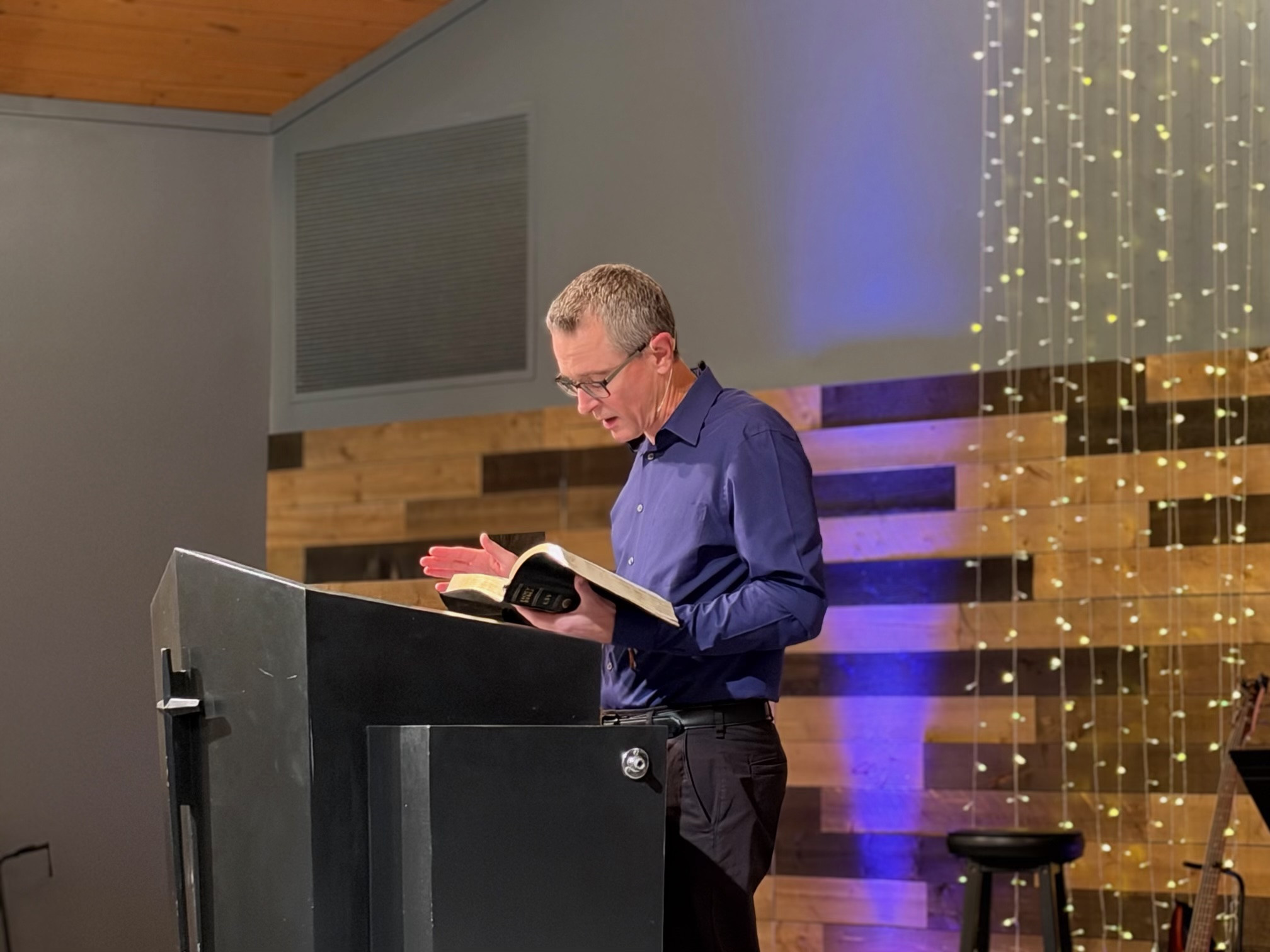
September 10, 2023
Dr. Michael A. Bond · Colossians
The following is a lightly edited transcript generated from the audio; it may contain small errors.
How’s everyone doing? Good. All right, we’re in the book of Colossians, chapter 2, starting in verse 9.
For in Him the whole fullness of deity dwells bodily, and you have been filled in Him, who is the head of all rule and authority. In Him also you were circumcised with a circumcision made without hands, by putting off the body of the flesh, by the circumcision of Christ, having been buried with Him in baptism, in which you were also raised with Him through faith in the powerful working of God, who raised Him from the dead. And you, who were dead in your trespasses and the uncircumcision of your flesh, God made alive together with Him, having forgiven us all our trespasses, by canceling the record of debt that stood against us with its legal demands. This He set aside, nailing it to the cross.
(Colossians 2:9–14, ESV)
That’s right, Father. Your Son Jesus—we thank You, Lord, that You are gracious to us day after day after day. Lord, we want to be a people set aside for Your own glory. We want to be a people that give You glory. We want to be a people that are faithful, Lord, to serve You and to be Your children. Father, we pray for Your blessing on the Christmas musical as they start preparing for the different songs they’re going to be singing. Be with the different workers and adults, Lord, and bring many family and friends for that performance and let them hear the gospel and respond in faith. Lord, may we continue to respond in faith to You daily. We thank You that we don’t live by bread alone, but by Your Word. And we pray, God, as we look into Your Word, that You would nourish us and feed us. And it would be to Your glory. And we pray this in Jesus’ name. Amen.
Okay, so we are looking at five things that God has done for us in Christ. And we’ve been looking at how we were filled in Christ in verses 9 and 10. Last week we looked a little bit about a motif seen in Scripture, the death, burial, and resurrection motif of Jesus. We’re also going to start looking at what it means to be circumcised in Christ, also buried, raised, and made alive. But these five key words—the fill, the circumcised, buried, raised, made alive—these five key words explain what God did for us in Christ. And God has been gracious to bless us with many things, as these verses show us.
So I want to recap just briefly the death, burial, and resurrection motif. These three key words—death, burial, resurrection—they describe the work of Christ that He’s done for us. Really the saving work of Christ. You could even say it’s a short description of what the gospel is in regards to Christ. Just turn briefly, keep your place in Colossians because we’re coming back, but turn to 1 Corinthians 15. 1 Corinthians 15, the Spirit says to us in verse 3:
For I delivered to you as of first importance what I also received: that Christ died for our sins in accordance with the Scriptures, that He was buried, that He was raised on the third day in accordance with the Scriptures.
(1 Corinthians 15:3–4, ESV)
So you see in verse 3, the died, and then verse 4, the burial and the resurrection. And that is a theme or motif, if you will, that you see over and over in the Scriptures. Romans 6, turn there and we’ll see the same idea. Romans 6 verse 4:
We were buried therefore with Him by baptism into death, in order that, just as Christ was raised from the dead by the glory of the Father, we too might walk in newness of life.
(Romans 6:4, ESV)
Again, we see the death, the burial, and the resurrection of Jesus emphasized. So this theme is all throughout the New Testament. Now some verses just focus on the death. Some verses focus on the burial. Some verses focus on the resurrection. But when we talk about the work of Christ, at least one of these three is going to be mentioned. Even the creeds see this theme, and they mention these same three key words. So we get in the Apostles’ Creed. How many people grew up in church reciting the Apostles’ Creed? How many people grew up with the Nicene Creed? Okay, like five of us. I did. Every week it was the Apostles’ Creed and the Nicene Creed. There’s probably some rule about when you switch in the church calendar to the other one, because you did the Nicene and then it’s like you started to get a little bit tired of that one and you went to the Apostles’ Creed for like six months. But I got them both memorized pretty well. In the Apostles’ Creed, it says, “He suffered under Pontius Pilate, was crucified, died, and was buried. The third day He rose again from the dead.” So you get the death, burial, and resurrection. Same thing with the Nicene Creed. “He was crucified for us under Pontius Pilate. He suffered and was buried. The third day He rose again according to the Scriptures.” They’re crucified as standing in place for the death.
So just briefly as a recap from last week, why is the death aspect important? Well, because He actually died. There was death. So He didn’t just faint—no, He was dead. And why did He die? To satisfy the wrath of God. To satisfy the wrath of God, to pay for the punishment for our sins. So what is the wages of sin? Death. What happened to Jesus? He died. Wages of sin is death. We deserved it. Jesus took our place. Why is the burial aspect important? Well, it shows that He really died. What do you do with dead people? You bury them. Okay. Three days in a tomb. Guess what, folks? He’s dead. He’s really dead. There’s a finality to it. And then why is the resurrection aspect important? Well, it shows that Jesus has victory over death. It shows that death couldn’t hold Him down. It shows the Old Testament prophecies about Him were true. It validates Jesus’ claims. What did He say? Destroy this temple, and I will what? I’ll raise it again in three days. All His claims are fulfilled and show that He was true to what He said.
Well, what I’m going to put forward to you today is that same motif of burial and resurrection is seen right here in Colossians. Now most people think, and we’re going to focus on the circumcision today, most people think there are two options when we hear that word circumcision. One, it can be a physical circumcision, just like that done to all male Jewish babies in the Old Testament and New Testament. What covenant is that a sign of? Let’s see if you guys can pass this one-question quiz. The Abrahamic covenant. All the covenants have a sign. Did you know that? One person does. All the covenants have a sign. This is the sign given to Abraham after the covenant is established. The Abrahamic covenant had circumcision, physical sign, as its sign. So when we think about circumcision, we can think of it as that, or the other one most people think of is like a spiritual circumcision. Deuteronomy 30 says, verse 6, “The Lord your God will circumcise your heart and the heart of your offspring, so that you will love the Lord your God with all your heart and with all your soul, that you may live.” And then Paul says in Romans 2, “For no one is a Jew who is merely one outwardly, nor is circumcision outward and physical, but a Jew is one inwardly, and circumcision is a matter of the heart, by the Spirit, not by the letter.”
So usually people are thinking of one of those two options when it comes to circumcision. Neither one of those is in view here. You might think this is referencing a spiritual circumcision. In verse 11 it says it’s a circumcision made without hands. Right? That seems to maybe, okay, there’s a spiritual aspect to it, but you might think, okay, he’s talking about like the Deuteronomy 30 passage, circumcising our heart. But that’s not what’s in view here. You might think it’s a physical—well that doesn’t really entirely make sense because the entire New Testament is against like a physical circumcision, it really doesn’t fit with the whole passage. So what kind of a circumcision? Well, whatever conclusion we come to, it has to make sense in the context that we’re reading it. So when it says in verse 11, “In Him also you were circumcised with this circumcision made without hands,” we have to put the next phrase into the proper understanding, “by putting off the body of the flesh.” So whatever that circumcision is, it includes a putting off of the body of the flesh. Well that kind of swings us back to the physical. So is it spiritual or is it physical? It is both.
This phrase, “body of flesh,” appears one other time in the entire New Testament. One other time. And guess what? It appears in Colossians just 20 verses earlier. Look back at Colossians 1 because it’s going to be important to helping us understand this. Let Scripture interpret what? Scripture. Colossians 1 verse 21:
And you, who once were alienated and hostile in mind, doing evil deeds, He has now reconciled in His body of flesh by His death, in order to present you holy and blameless and above reproach before Him.
(Colossians 1:21–22, ESV)
What is meant in chapter 1 of the body of flesh? What’s that referring to? I mean it’s not hard. There’s no trick question here, folks. Jesus’ physical body, right? What has He done? He’s reconciled you in His body of flesh by His death. His death, right? How did He die? He was placed on the cross. His physical body was up there and He shed His blood for us. So the meaning of the body of flesh in chapter 1 is His physical body. Well, when did Christ put off His body of flesh? On the cross. That’s when He did it. He laid down His life. He bore our sins. His body was punished. His death secured our life. So He laid down His life and His physical life expired. His body was lifeless on the cross. Was there any life in His body? No, He was dead. So He put off His body of flesh, so to speak. Jesus no longer had flesh, though His spirit was quite alive. Well, who did this? Who put off Jesus’ body of flesh? God, I mean, ultimately, right? Through the hands of the Romans, but God is the one who did it. It is the one made without hands, verse 11. So God cut Jesus. This is the circumcision that it’s being talked about. He cut Him, but it wasn’t just a small cut. It wasn’t just some thing that happened to little baby boys eight days after they were born. No, it was a big cut. There was a lot of blood and there was a lot of pain. It was intense. It was excruciating. God cut Jesus and it was messy and vile and disgusting. And that’s what He did for us. That’s what He did to redeem a people for His own. This is that same death, burial, resurrection motif. What Paul uses the word here, circumcision, is to describe what God did to Jesus. He cut Him, but it wasn’t a small cut. He cut Him to the point of death, and it’s God who did it. That’s why it’s made without hands. So it’s both spiritual. God is the one doing it, but also physical. He actually cut Him. There was a physical body, and the physical body actually died.
Think about that for a moment. When Christ’s body, when it was cut, it’s saying that we were cut as well. “In Him also you were circumcised with the circumcision made without hands.” When God cut Jesus, He cut us. You’re like, I don’t know about that. Well, what does Galatians 2:20 say? “I have been crucified with Christ. It is no longer I who live, but Christ who lives in me.” It is the same exact idea. We’ve been crucified with Christ. We’ve been cut with Christ. And what’s happening? The old man is gone. The old man is dead. The thing that happened to Christ, the crucifixion, we were part of it. I’ve been crucified with Christ. The thing that happened to Christ, the crucifixion, we participate in it. How? Because we’re in Christ. We’re in Christ. The old man is dead, but the new man is alive.
Look at Romans chapter 6. We looked at it earlier. We’re going to look at just a couple verses later. We read verse 4, pick it up in 5 of Romans 6:
For if we have been united with Him in a death like His, we shall certainly be united with Him in a resurrection like His. We know that our old self was crucified with Him in order that the body of sin might be brought to nothing, so that we would no longer be enslaved to sin. For one who has died has been set free from sin.
(Romans 6:5–7, ESV)
So when it says you were circumcised back in Colossians, I mean that’s talking about us. And it’s saying that the same thing done to Christ was done to us because we were in Christ. You died. You were crucified with Christ. You were cut with Christ. And you’re like, well what about that passage, that little phrase, a couple sentences later in Colossians where it says it’s the circumcision of Christ? In the Greek, that “of Christ” is a genitive, and it is one of the most challenging, I’d say, parts of speech, even in the English language, but even more so in the Greek, because there’s so many different ways you can understand genitive, even in English. The bottom line is it can either be a subjective or an objective—not subjective as in terms of, oh, how do I feel, but subjective in terms of the subject or objective in terms of the object. So is Christ the subject of the circumcision or is He the object of the circumcision? Does that make sense? In other words, is the circumcision performed by Christ, or is the circumcision performed on Christ? And I’m submitting before you that the way we’ve understood this passage, the circumcision is done to Christ. Oftentimes we just see those genitives, the circumcision of Christ, and we just automatically assume that it’s something that the person who possesses it is the one doing it. That’s what our automatic English thinking is, mine included, because we’re usually used to thinking of genitive, that of word, the book of Sean. Whose book is it? It’s Sean’s book, right? And Sean likes books. He’s got lots of books. So whenever we see that, we always think possession. That’s not what’s going on here. It’s showing that He’s the object of the circumcision. The circumcision done to Christ.
So here’s the thing. Think about our identification with Christ for a moment. I mean, the gospel message is the death, burial, and resurrection of Jesus. It is because of that—if you take away the death, burial, and resurrection, there is no gospel. There’s no gospel. You got to have Jesus, and He has to die, and He has to be buried, and He has to be raised again. All of those things we have to have in order for us to have a gospel. Well so it’s the death, burial and resurrection of Jesus. But what do we find out? It’s the death, burial and resurrection of us. We died with Christ. We were buried with Christ. And we were raised with Christ. Romans 6:4 again. We were buried, therefore—Christ died, you died. He’s buried, you’re buried. That’s how you have the baptism. That’s what you get that beautiful picture, right? Going under the water, that’s just like you being buried, being placed in the tomb. What comes out? The new man, the new life, raised with Christ. That’s why I just think the picture of immersion with baptism is so beautiful. Buried with Christ, raised with Christ. We’re raised up. Ephesians 2 says that same idea in verse 6, “raised us up with Him.” Raised us up with Him. How is this possible? Because we’re in Christ. What happened to Christ happened to us.
And here’s the thing, we receive the benefits. But we did nothing to earn it. We received the benefits, but we did nothing to earn it. Did you suffer on the cross? No. Did you bear the wrath of God? No. Were you cut by God for the sins of mankind? No. Were you laid in a tomb? Not yet. Did you raise yourself from the dead? No. No, no, no, no. But we get the benefits because of what Christ did. He earned it and gave us the benefits.
Picture for a moment if you got seriously injured to the point where you just like could not work at all, any job, right? That’s how you’re so seriously injured, you can’t do anything. And you don’t know what you’re going to do in terms of providing for your family. Your disability is so severe, there’s nothing you can do. A couple weeks after that injury, you log into your bank account online and you see like there’s this huge deposit of money. And you’re like, well that’s interesting. Right? Praise the Lord. And you find out that someone went and took over your job and is giving you the paycheck. But they’re not just giving you the paycheck. I mean, they’re giving you the health insurance coverage too. And they’re giving you the 401k plan. They’re giving you everything. They’re doing all the work and they’re letting you have all the benefits. That’s really what Christ has done. What did you do to earn it? Nothing. You can’t earn it. You have the inability to do so. You can’t earn it. You’re disabled and really you’re dead. But this is why your identity is found in Christ. I mean, we can search everywhere. We can search everywhere for meaning. And a lot of times, the sins that we’re doing, we’re really searching for God. We’re really searching for satisfaction in God, and we’re trying to find that satisfaction in so many different places. But think about our identity. God is our Creator, He’s our Lord, He’s our Master, He determines our value and our worth. And we are entirely dependent on Him. It’s just like the person that takes over your job—you’d be entirely dependent on that person. You’re entirely dependent on Christ. And everything that you are comes from Him. Everything that you have comes from Him. I mean, look at all the things that He’s done. You couldn’t be buried unless He was buried. You couldn’t die unless He died. You couldn’t be raised unless He was raised. All of those things He has earned for you. He’s merited it for you.
And sometimes there’s all sorts of distractions. Sometimes things get us off course. Sometimes things catch our attention. We’ve got mice in our house right now. Thankfully, they’re, I think, in the attic technically. But Trinity had been talking for a couple days, maybe even longer—sorry, Trin—that she’d been hearing little, you know, different noises. I was thinking, okay, maybe it’s just like something on the roof, but she kept hearing it, kept hearing it. I’m like, okay, okay, I’ll get some, I’m going to get some mouse traps. And so she’s like, well, her room is like right next to part of our attic, if you see her house, and it’s right above the attic. So I’m like, okay, I’m going to put them up in the attic above our garage. And so I set two, I don’t know why, but I just set them pretty close to each other. It really doesn’t make sense. Because you’d think if one got caught, the other would see it and be like, I’m not going there. Right? But I set them, and the very next morning I checked, and there’s two dead mice. Okay? I mean, I don’t know what the second one was thinking when he saw his little buddy there dead, okay? I don’t know what was going through his mind. I know the last thing going through his mind was that little piece of metal snapping shut. But sometimes we see people making all sorts of stupid decisions, and we’re just like, oh, I’m going to join them. True? We’re like that mouse. I’m like, how can they not see that? So I was like, well, I’m two for two. I’m going to put another trap up there, you know? And I checked this morning before I came to church, there’s a dead mouse. I’m like, I’m going to start a little side business here. But we can see people in their folly, and we follow them right into it sometimes. Some really, really stupid things. And we forget who we are in Christ. We forget the identity that we have in Jesus.
Brothers and sisters, God cut Jesus to the point of death to save you. He circumcised Christ, it says, and it wasn’t just a small cut, it was all the way to the point of death. He did that to fulfill the covenant that He and the Son made to redeem a people for His own. He did that for us. God in Christ reconciling a people for His own. We have to trust that that’s for us. We have to turn away from our sin—the Bible calls that repentance—and we have to trust that that was for us. We have to trust that God can do that. We have to believe that that’s what God did in Christ. It’s one thing to believe it as a historical fact. It’s another thing to trust that God did that for us. We have to take that from historical fact. We can have a knowledge of all sorts of things that have happened in the past. But we have to trust that that was done for us. That was done for our forgiveness. That was done so that we could be forgiven of our sins. That was done so that we did not have to pay the penalty for our sins before a holy God. One day we’re all going to appear before Him. One day every single person, and we’ll have to account for our sins. If you don’t have Jesus, then you will pay the penalty and God’s wrath will be poured out on you. If you have Jesus, then the wrath was already poured out on Jesus. Jesus took your place. He was the substitute. And guess what also He does? He doesn’t just take away your sins, He does something else. He gives you His righteousness. That’s part of what we’re going to be looking at, being made alive together. Well what does that mean? I mean you have the righteousness of Christ now. When you are forgiven of your sins, yes, that just brings you back to a morally neutral place. But you need righteousness. What did Jesus talk about? You have to be better than the Pharisees if you want to go to heaven. You have to be perfect. Well how is that possible? It’s not apart from Christ, but when He gives you His righteousness, it’s like the double substitution. He takes your sins, but then He gives you something. He gives you His own righteousness. Then you do have the righteousness required by God to come into His presence. Then you have what you need. You’re right in His sight, not just morally neutral. You are righteous, you are justified, you are sanctified, you’ve been made holy by a holy God.
That is available to every single person here within my voice. You can trust today and have the forgiveness of sins. You can trust today and have the righteousness of Christ given to you. You can trust today and be adopted into the kingdom of God. He can become your Father. I encourage you today to trust. Repent of your sin and trust in the finished work of Christ. He offers it freely. What does He say? My burden is what? It’s a light burden. Does He have a burden? Yeah, but it’s light. If you follow after Christ, that doesn’t mean it’s all roses and amazing ice cream every day. Now, there’s some vegetables involved too, but the burden of Christ is light. We find out that He carries a lot of that burden for us. He’s with us, He walks with us every single day. He walks with us through those trials. He walks with us in the fire. He’s with us. He’s the one carrying us at times. We stumble. What does He do? He’s there to lift us up over and over and over. We serve a very gracious Savior. He did that out of a love for His heavenly Father.
Father, thank You for all the riches that we have in Jesus. Thank You that we’re made alive with Him. Thank You that we died, we’re buried, and resurrected with Him. That He earned for us what we couldn’t earn ourselves. Father, I pray right now even You’d give people for the first time the gift of faith. Let them trust in You. Let them see their sin as it really is, and how You have to be just, Lord, and punish it. So may they accept You, Lord. May they trust in You and what You did through Your Son. May they turn away from their sins and walk in faith towards You. We thank You that You are a good and gracious heavenly Father who loves us so much, who didn’t leave us in our sins, but provided a way back to You through Your own Son Jesus. Jesus, thank You for Your sacrifice, for everything that You merited for us. We are blessed and blessed and blessed and blessed. Spirit, we ask You to do Your work now in each of our hearts. Bring about the regeneration of souls today and produce Your fruit, the fruit of the Spirit, in our lives. Produce it in plenty. We ask for the glory of God. Amen.