
March 11, 2017
LFC2017: A Global and Local Gospel
Guest Speakers
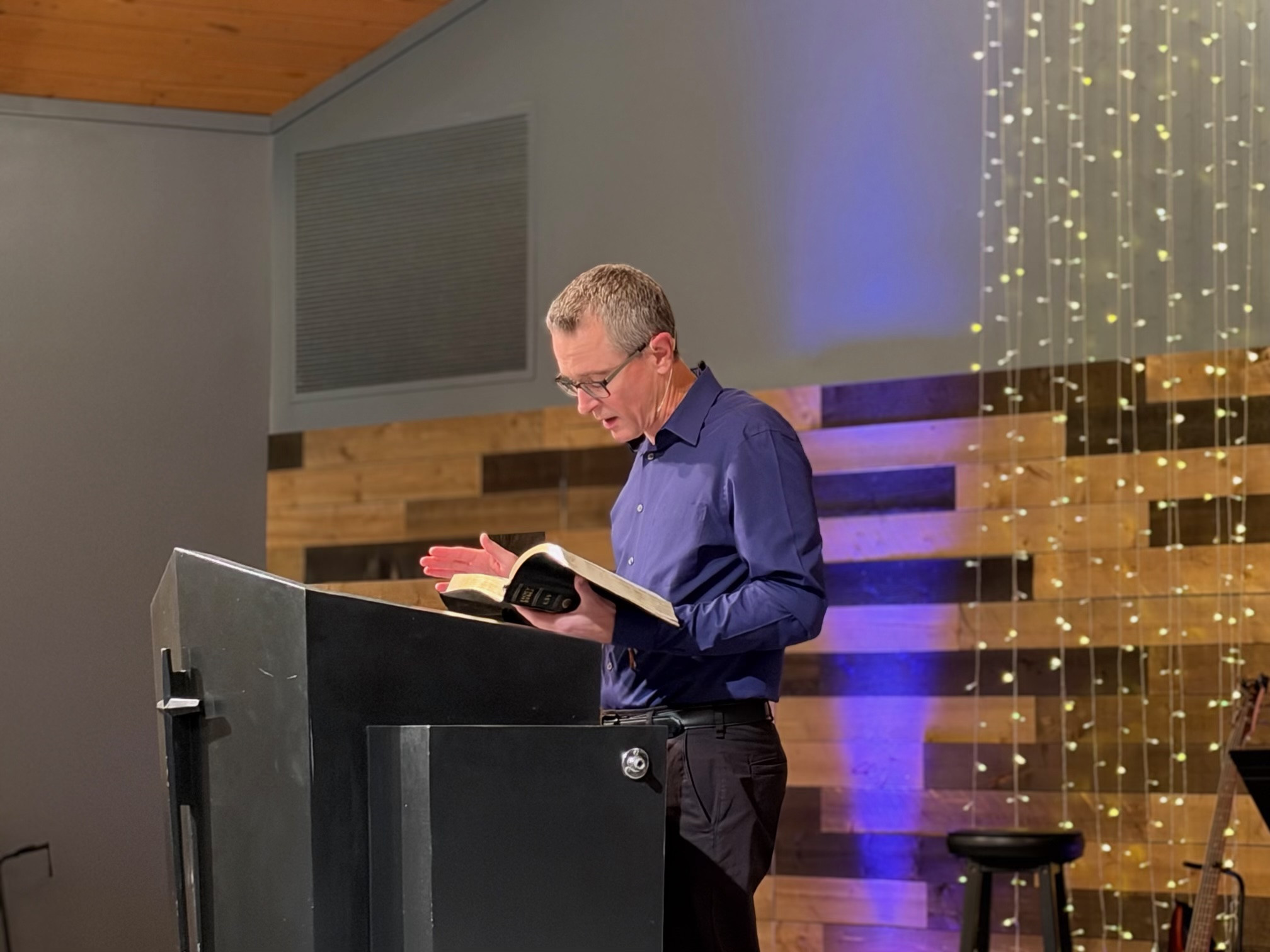
guest speaker Dr. Rob Myers
The following is a lightly edited transcript generated from the audio; it may contain small errors.
We’re actually going to do something we’ve never done before. Start a session early. That must be moving. Does anybody here like Chick-fil-A? All right. In an hour. We’re going to be hearing from Dr. Rob Myers. Rob’s a long time friend of Lauren and Mike and others in our community. I’ve known his wife Michelle since she was in diapers believe it or not No Really After diapers Okay, she was 10. Okay, she got out of diapers when she was nine. Okay, she was 10. All right. Technicality.
All I meant to say is I’ve known her for a long time. Okay, that’s all. That’s all. So Rob is, Rob and Michelle are very dear to us on a personal level. And of course Rob was called to go to, I’m gonna get the university wrong, is it in here? Bethel, Bethel College, we taught mathematics. Rob is actually a certified genius, by the way. One of the smartest people I know, and I know a lot of smart people. He’s one of the smartest people I know.
He holds three bachelor’s degrees. He has a PhD in mathematics. He’s a smart guy. But God called him from the, from campus, teaching in the campus and doing campus work too, really an international ministry of evangelism to the deaf. So it’s very exciting. And he’s going to talk about the vision for evangelism worldwide and local, and also about what he and Michelle are doing with DOOR International. So let’s welcome Rob warmly. Rob. Dr. Rob Myers. And if I forgot to mention, he’s very tall.
When I saw him this morning, I’m like, man, either you grew or I shrunk. I don’t know, he just, and he’s like, no, you just forgot. That’s yours. Let’s see, is this, yeah. You’re on. Yeah, I’m on. You’re on. And for those who have seen my kids before, we get even more comments like that, because our oldest John who’s 14 is six. Three? Wow. So, he’ll probably be taller than me, but I’m guessing all four of them will be taller than me. So, that’s really exciting.
My pictures didn’t go with the background, so it’ll look a little different at this time, but that’s okay. Go ahead and head to the first slide.
Part of what I wanted to do today, as David described, we work. I have my PhD, I guess, still in math. And worked as a college professor for 10 years. And then God, over the course, it wasn’t just one night, but it was the course of about eight years or so of being involved in the deaf community, which is kind of a story in and of itself that I may describe at the end here. But God did a work, I think, in our whole family.
And it wasn’t that college ministry wasn’t worthwhile. It wasn’t that what I was doing in discipling students and working on college campuses. We felt like God had called us to that point for that season. We were equipping people to go out and be ministers in the kingdom.
But at some point, God brought this huge need in front of us and that need was God used that to stir our hearts and so one of the things that I just want to encourage all of us today is as you see a need and as God stirs your heart in that need that’s part of God’s call in your life that God as he equips you with skills and as you see a need and as he stirs passion in your heart that he’s calling you to do something in the kingdom.
So let’s pray and then I’ll kind of give you an outline for what it is that we’re gonna be looking at this morning. God again, we just come before you and we stand before you as you the King of Kings and Lord of Lords, the one who is worthy of all praise. We bow before you Jesus.
At some point every knee will bow and every tongue will confess that you are Lord and it’s our desire to see as many people as possible, worshiping you before your throne, saying Worthy is the Lamb, who is slain. God used this conference, used today. May we not limit you in what you may do this morning, this afternoon, but Lord, burst through the preconceptions that we have and do a great work inside of our hearts.
We love you and we lift our hearts to you in Jesus’ name. part of what
I want to do this morning is paint kind of a global picture of the Great Commission. The organization that I work with is actually a partner organization to a number of very large organizations that work in Great Commission areas and we have a lot of conversation about where is the Great Commission right now? How many people are supposedly yet unreached? How many people still need Bibles? What does it take to reach a people group?
So you’ve seen some of the focus being very local, and we need that, and we’re gonna actually look at a scripture that you’re very familiar with that talks about local and global focus in the Great Commission. So I wanna give you a little bit of an overview I I promise whenever anybody hears of the Great Commission. I have a PhD in math and doesn’t know a lot of my background. They think, boy, I’m glad this came before lunch instead of after lunch.
I promise not to bore you too much. I will give you a few numbers because I can’t escape. That’s part of who I am. But I think that kind of thing is healthy too. So very strongly connected to the concept of the Great Commission is a concept called UUPGs. And
if you’ve never heard that concept, UUPG, that’s something I want to introduce to you today because you’re probably gonna hear more and more of it. Then we’ll talk about resources on that area. And we’ll talk about death. And one of the things that we kinda, whenever we talk about what we do, there’s immediately things people assume about death ministry.
And so there’s a couple things that I wanna, that I wanna share with you to help you understand what exactly is that we do, how is it connected to the Great Commission, why we talk about death as people, and then in general, what do we need to do to reach and unreach people group, and how do you all, how do we make that practical in terms of how you can engage with it.
I wanted to start, if we’re talking big picture, if we’re talking about vision of the Great Commission, we need to talk about the goal, the end, the purpose why we’re here. Why is it that when we’re saved, we’re not just, whoosh, brought back up to heaven? It’s because, it’s exactly what Mike was sharing. We’re ambassadors for Christ. This passage is, most of you may be familiar with it, Revelation chapter seven.
John writes in this vision that he has of heaven, “’After this I looked and behold, “’a great multitude that no one could number, from every nation, from all tribes and worshiping in languages, standing before the throne and before the Lamb, clothed in white robes, with psalm branches in their hands, crying out with a loud voice, salvation belongs to our God who sits on the throne and to the Lamb.
And all glared around the throne and the elders and the four living creatures, and they all fell on their faces before the throne and worshiped God saying amen. Blessing and glory and wisdom and thanksgiving and honor and power and might be to our God forever and ever. Amen. You can back up just one. Amen, amen, praise God.
It’s interesting, this was, the few of the verses that I’m gonna share as we start out this morning, this morning are really closely tied to this transition that we made into working in the ministry that we work in now. And this one was particularly, I think, stirring for me because there was one point when I read this, and I had this picture in my head of people standing before God’s throne worshiping, and there being these kind of open spaces right now, where people aren’t there.
Maybe they might represent. Whole groups of people. Know Jesus. And we have the opportunity as his ambassadors. To see that change. As we open our mouths as the Holy Spirit prompts us and uses us in the lives of others. We have that opportunity to change and to change that and to see make eternal impact on the lives of people forever. Go ahead to the next one. So now, if that is the vision, if that’s why we’re here, how do we get to that place?
How are those spaces filled in? Well, this is another one of these key passages in the Great Commission, Romans chapter 10. Paul says, for everyone who calls on the name of the Lord will be saved. How then will they call on him in whom they have not believed? How are they to believe in him if they haven’t heard? And how can they hear without someone preaching? And how can they preach without, unless someone’s sent?
As it is written, how beautiful are the feet of those who preach the good news? So Paul lays out in this context, how are we gonna reach people? Well, they can’t believe unless they hear and they can’t hear unless someone shares. Okay, preach doesn’t necessarily mean somebody standing up here and preaching exactly what Mike and Andrea were describing. When you share, that’s part of this. And how can they preach unless they’re sent? And that’s part of what we’re here for.
It’s our desire, all of us, God sending all of us out to share His good news. Go ahead. And now, just backing up, since we’re talking about Great Commission, we can’t get away from hearing this, even if we heard it yesterday, it’s worth hearing again. Jesus came and said to them, all authority in heaven and on earth has been given to me.
Go and make disciples of all nations, baptizing them in the name of the Father and the Son and the Holy Spirit, teaching them to observe all that I’ve commanded you, and behold, I’m with you always to the end of the age. Go ahead to the next one. Just one quick thing that I want to point out here, that word all nations, go ahead and… I had to throw some Greek in too, because Mike’s here, so. So, panta tae ethne, go ahead and hit that.
Many times I think when we see that word nations, we think like countries, but that wasn’t really the conception when the writer who was writing, We’re talking about groups of people. So we’re gonna use the term people groups. And people groups just has, it’s this idea of a people who have a number of things in common, typically language, some ethnic background, various traditions that they have in common. So God’s calling us to make disciples of all ethne, of all people groups.
Go ahead to the next one. And this verse, Acts 1.8, is kind of the framework that I want to use for describing what it is we’re going to talk about today. You will receive power, Jesus is talking to the disciples here, when the Holy Spirit has come upon you, and you will be my witnesses in
Jerusalem and in all Judea and Samaria and to the ends of the earth. Now, many of you have encountered this verse before, go ahead. But there’s four things that Jesus points out here. Jerusalem, Judea, Samaria, and the ends of the earth. Go ahead to the next slide. And there’s a progression that happens here. One of the ideas here is that Jerusalem is your city. This actually traces, in one sense it traces the advancement of the gospel.
The gospel first started in Jerusalem and then it expanded to Judea, and then it expanded to Samaria, and then it expanded out into the ends of the earth. But it’s also a paradigm for how God uses us. He uses us in our city. He uses us in our people group that we have in common with. He uses us with people that are pretty close to what we’re like but not quite. That’s what I’m gonna call proximate people group.
And then he still uses us to reach the ends of the earth. And that’s kind of this paradigm as you see, as we talk about missions in the various contexts today, you’ll see that fit in different ways. So it’s, God’s calling me to share the gospel with my neighbor and with the girl at Starbucks. God’s also calling some of us to go. He’s not calling all of us to go, He’s calling some of us to go to the ends of the earth.
That command, actually, I’m not gonna have you back up because it’s gonna be too complicated, but. Matthew, the Great Commission, Jesus says go and make disciples, baptizing and teaching, there’s four verbs there. Anybody know which is the most important? Have you heard this before? If you’ve never heard this before, this is actually really important. It says, Jesus says go, make disciples, and baptizing them and teaching them. In the Greek, one of those words is the most important. And all the other ones are describing that.
Which one do you think it is? Yeah, it turns out, go is the one that I thought it was. Death for emphasis. Oops. Go is the one that I thought it was. It’s actually not go. It’s make disciples. So another way to translate that passage is, you’re going, make disciples, baptizing them and teaching them. So God’s call on all of us is to make disciples in our going.
And that going may be God calling us to move to Russia or to move to China or to move to St. Charles or to Grand Rapids, Michigan, in our case. All right, go ahead. And one more verse, this is another one of these classic verses that’s connected in. And this gospel of the kingdom will be proclaimed throughout the whole world as a testimony to all nations and then the end will come.
And the note that I make here, go ahead and hit it one more time, is that that same phrase is there again, all people groups, all F and A there. So let’s talk a little bit about UUPG here. What is a UUPG? This sounds like one of these in, an acronym that you’re in the in crowd if you know, I know what a UUPG is. It’s unreached, unengaged people group. Okay? So if you’ve never heard this phrase before, I wanna totally demystify this.
There’s nothing that’s supposed to be super like Gnostic about this, like, we know what a UUPG is. So there’s nothing about that. So. Ah ha ha ha ha ha ha ha ha ha ha ha ha ha ha ha ha ha ha ha ha ha ha ha ha ha ha ha ha ha I won’t even go down that road. I lived in, for those who don’t know, I lived in Berkeley for like five years, so. Yeah.
Unreached means that there are less than 2% of that people group are believers. Okay, and then unengaged means there are no workers working within that people group. So a UUPG may be a typical group that you may expect, like the Uyghurs in Western China. That is an unreached, unengaged people group.
But there are other unreached, unengaged people groups that represent groups that are simply break off from, You might have a group here like Japanese, and then a group of Japanese people move to the US and they all cluster in one area, and they’re unreached, unengaged. So you can have, for instance, the Japanese in the US may be an unreached, unengaged people group. Does that make sense? Okay.
So just to kind of make sure that this illustration makes total sense, if you think of, Jesus used this analogy of the gospel being seed being put out into a field. And some of it bore fruit, some of it the enemy snatched away, some of it grew up and then was choked. If you think of a totally unharvested area where there’s nobody working there, that’s a UUPG. That’s an unreached, unengaged people group.
If you look at this second, go back, sorry, if you look at this second picture, there’s somebody there, and they’re sowing seed, but there’s nothing growing yet. That’s an unreached group, they have less than 2% believers, but it’s not unengaged, meaning there’s people, they are working, it’s just we don’t see the fruit of that happening yet. Okay, and then, obviously after work we see engagement, we see fruit happen.
So that UUPG, we can talk about unreached people groups, that’s that middle one, but when we talk about UUPG, It doesn’t just mean there’s no believers, there’s nobody there. There’s nobody working. Let’s go on to the next slide. So I put a couple of these things in your outline just so you’d have them and you wouldn’t have to frantically scratch some of these references down. But there are a couple of places where, if you’re curious, how would I figure out what the UUPGs are?
Where are people not? Where is the gospel not, and where are there no people working there? There’s actually a website called Finishing the Task, and the URL is there, and that website, go ahead, has a list of every known UUPG worldwide. There’s a history behind how this list came about that’s really interesting, and there’s actually a video on Finishing the Task website, and I’ll let you go and see some of that, but this has, all kinds of information.
It has where are these people groups, what language do they speak, how many are in there. And then I had to cut off the list because the thing kind of goes, it has like 11 more columns to the right. But you start to see it on the right side, it says WS and OS if you have like eagle eyes, you can kind of see that at the top. It will tell you what resources these people groups have. Do they have written scripture?
Do they have oral scripture? Do they have the Jesus film? Do they have a church planting movement started there? Do they have anybody doing evangelism there? And it’ll say yes, yes, no, no, no, that type of thing on this, okay? Go ahead to the next slide. Another great resource is Joshua Project. Joshua Project, any of these are kind of limited according to the data that they have.
But Joshua Project is one of these classic areas that if you’re like, how many people are unreached in whatever country or whatever city or that type of thing, you can typically get a lot of that information from places like this. In fact, if you click in and the, if you were to get on the website, I’m not asking you to do that. You’ll see, it’ll say progress level, you see that kind of bar graph on the, I can’t escape math, it’s like, sorry.
and that bar graph on the lower left side, you see that big red line? That’s the, like, on a scale of one is totally unreached and five is really reached. The ones are the, there’s nothing there. Okay, and if I were to click on that, go ahead and do the next slide, what it’s gonna do is it’s actually gonna pull up people groups, it’ll pull up these dots, it’ll pull up people groups according to where they are. pull up people groups according to where they are.
Okay, so if nothing else, if you’ve been like, I feel like God’s calling me to pray for people groups who have no workers and no gospel, this is one of the great opportunities to do that. You can pull this up and they actually have daily a people group you can pray for. So, I’m gonna go ahead to the next one. Another group that works internationally that collects a lot of statistics the IMB. Some of you may be familiar with the name David Platt.
He wrote the book Radical. He about a year and a half ago became president of IMB. And IMB is the mission’s arm of the Southern Baptist Convention. But they keep a lot of statistics as well, so there’s a lot of good information on their website. Go ahead to the next one. And one last one one? I’ll talk about the, I’ll talk about our website in a second because we have some great information there too, but I a m going to get to and get to that.
and get to that at the end. One last. One last thing, there’s a book, some of you may be familiar with it, it’s called Operation World, and it’s… And it’s got all kinds of information about different people groups as well. Thank you very much. That’s a great resource to be praying for. It’ll tell you in a particular- It’ll tell you in a particular people group, what percent is Muslim, what percent is Hindu, Shinto.
Shinto, all kinds of different religions, and it gives recommendations for how to pray. So I want to back up now to the UUPG list that I showed you. And UUPG means what? Unreached, unengaged people group. Great. And I’m going to highlight something here. If you had eagle eyes, I’m not expecting you to necessarily be able to read that. But that group right there is a group in Afghanistan.
But that’s It’s group number 641, and they’re called Deaf Afghans. And there’s 312. Okay. If you were to scan this list, if you go all the way down, you have a disability that you you actually see listed here is death. Go ahead to the next slide. So, in fact, out of this UUPG list, if you just look at groups according to number, 5% of them are death.
If you look by population, because you can have lots of groups, but they’re really small, and you can have some groups that are big, if you look by population, 10% of those groups are actually death, 10% of the people. And if you look at the groups over 100,000 that are left, there’s nobody working and there’s no gospel, 20% of those groups are deaf. So I wanna address a question that immediately comes, why do we have deaf on this list?
I think this is an important thing to answer because I think you can see, deaf people are actually a fairly substantial portion of the Great Commission, the task that’s left. So why are deaf people on this list? Go ahead. I wanna run a little experiment. When you read this sentence, what’s happening? What’s happening? Yeah. You hear it in your head, right? That carries more significance than I think you realize.
Most people think deaf people are, they can’t hear, but they can see, So therefore they can read. So therefore we give them the Bible and they’re great. That turns out to actually not be true. In fact, if you were to think about how you learned English, you were fluent in the language by five or six because you heard it and you spoke it.
And then when you went to learn to read it, you learned phonics, which you were hearing, associating words that you already knew with these symbols on the page that you had sounds for. Imagine all of that is thrown out the window. So click onto, I’m gonna change all those letters to things that don’t have sounds anymore, but you still have the advantage that you know the language. You gotta throw that out too. Now imagine trying to learn to read.
It’s a lot more like pattern recognition for a deaf person who’s never heard sound before. Okay, go ahead. So the thing you need to understand is deaf people, 90% of deaf people are born in homes where neither parent knows sign language. And out of those parents, only a very small fraction, it’s about 10 to 15% in the US, learn to sign with their kids. So in other words, most deaf people have this experience of growing up and they can’t communicate with anyone in their family.
Very, very, very common. So the statistic that we know of from the World Federation for the Deaf is that 90% of deaf people struggle with reading in general worldwide. And it’s not a literacy issue, so much as a language issue, go ahead. The thing that most people think when they see that number is we need to teach deaf people how to, how to read. But in fact, sign language is the natural language for deaf people.
So what we really need to do is to give people resources and training in their language. Like if there were a bunch of people who were unreached in, let’s just say, in downtown St. Louis and they spoke Spanish, our solution to reaching them wouldn’t be let’s spend a bunch of time teaching them English and then give them English resources and train them in English. It would be, let’s generate a bunch of resources in Spanish, empower them, and help them reach their own people.
So the misunderstanding that a lot of people have is that deafness, because it’s a disability, they say, oh, special needs. But it’s not about special needs. What happens is that the disability creates a different language, and once you’re in a different language group, all bets are off and you have to, you have to try to reach that language group in the same way that you’d reach any other language group. Go ahead.
So what we often have to battle in terms of just kind of helping people understand this is that disability leads to a different language and then therefore a different amount of information. No conversation, no reading, none of that information at all. And that creates all kinds of issues socially, educationally, vocationally, and from a ministry standpoint. So I want to tell you a little story here.
It’s that piece that we’re actually going to focus on just to kind of give you a little bit of a glimpse of what we do. Go ahead to the next slide. I want to tell you a brief story here about a guy, an Indian guy named Jay. And Jay, Jay grew up in a family, I actually know his brother is a very, very good friend of mine.
He grew up in a family of five in, I wouldn’t say rural India, but probably not necessarily in one of the major cities in India. And Jay’s dad was actually a pastor, which is kind of rare in India, but he was a pastor. And Jay was the only deaf kid in his family. And every Sunday, every Wednesday, they would go to church. But Jay couldn’t understand, his family never learned to sign, there was no real opportunity for them.
So he couldn’t really communicate with anybody in his family, and he would go to church and he’d watch his dad preach, and he watched the worship, and he’d see all of these things, And he had no idea what’s going on at all. So typically what he would do is just sit in church and draw. Because he could see see things around him so he would draw. And he did that for about 25 years. And I mean imagine he grew, he was in a Christian home.
That, he was right there. The gospel was right there. But he didn’t have access to it. And then something happened. And that thing that happened, I’m gonna hold off on it. I want to circle back to the story in a second, and we’ll see what happened to Jay. So just to give you a global picture for the death portion of this great commission, there’s an estimated 70 million death people worldwide. It’s about 1% of the world population. And they are sitting in that unreached category.
They’re less than 2% are estimated to know Christ. What’s interesting is one of the biggest hindrances to reaching this UUPG is that we just don’t know about them. We just don’t know. It’s not like we’re purposely ignoring. In this case, we just don’t know. So there are typically two types of questions that we run into. One of them consists of language questions, things like do deaf people use Braille? I’ll just let that one sit for a second. Brails for blind people, right? So, in fact, I…
All right. I have to tell you a story now. Every one of our deaf staff, we have about 180 staff worldwide, about 85 to 90% of them are deaf. And every deaf staff member that we have has at some point encountered somebody handing them a Braille menu. And the best, one of the best stories that I have is that one of our staff was flying and he was with some other people, he was with somebody who was hearing and they were having a sign conversation.
One of the flight attendants came up and she saw that he was deaf And she was like, oh, and she had this great idea. And she went back. And she brought the Braille menu and handed it to him. And he just kind of looked at it. He looked at her. And he looked at it. And he looked at her. And he was kind of like this. And then he took it and started rubbing it on his ear. It was good.
He didn’t see her for the rest of the flight. So that’s the question that we always ask in front of people, just so nobody asks us later because that’s the question not to ask. But there are very, very honest, typical questions that we hear from people. Is there one sign language? No, there’s almost 400. Can deaf people just read? Isn’t sign language just spoken language in sign format? No, it’s totally different. Grammar’s different, structure’s different, everything is totally, totally different.
So we get language questions, but we also get questions about identity of this deaf person themselves. If I go back to that passage that I read earlier in Romans, that passage was classically used by the church for many years as a proof text that deaf people can’t be saved. Because they can’t hear. Yeah, that’s a pretty bagged exit Jesus. So in fact, we have that doesn’t typically happen here in the US but in developing countries we very often run to communicate with them before.
So there’s an identity issue. So in one sense, the reason that all these deaf people are unreached is that we haven’t been aware, but we should be aware. And so that’s kind of a big first step for us. Go ahead. So if we want to reach deaf people as an unreached people group, simply as a language group with their own language, how do we do that?
And this is where we kind of step back we say what is the kind of strategic approach, if there’s an unreached people group somewhere, how do we reach them? So this applies not just to deaf people, but very, very broadly.
So if we wanna reach them with the gospel, there, there’s an organization called the Issachar Initiative that’s kind of identified, they’ve summarized this, there’s four main strategic things that we look for, and then underneath that, there’s kind of a foundation that I’m gonna all describe later, but there’s four main things that we look for. The first one is giving them scripture in their heart language. People have to have access to God’s word. We, as a ministry, this was long before I got involved with DOR.
But we, as a ministry, tried training people and doing evangelism without the Bible and sign language. We tried basically giving them summaries and stories and other things. That wasn’t enough. People needed God’s and we realized that through various sort of trial and error. So scripture, I mean you can imagine how important scripture is in your life. If you didn’t have it, if you had no access to it, how are you going to grow in your own faith, much less share it with somebody else?
Second thing is training workers. There have to be workers, and these can be workers close by, or we can be talking about indigenous workers. The third one is evangelism and the fourth one is church planting. Now there are some other kind of things that may come into your mind things like well, what about developing leaders?
Well, that’s kind of integrated into into some of these areas, but these are kind of the classic four There’s a fifth one that sometimes added called orality If you have a people group that doesn’t have a written language which many times trying to teach them to read and write isn’t the best approach. It’s just to meet them where they’re at. I didn’t include that here, but that’s sometimes added in there as well. So just out of curiosity, let me ask a question.
How many people groups overall do you think there are? I should have probably asked this at the beginning. to divide people in the world into people groups, kind of according to what I was describing earlier. How many ballpark, how many would you guess there are? 5,000. 5,000, that’s a pretty close ballpark estimate. Did you want to say something? Or? 10,000. 10,000? It’s actually between these two numbers, so it’s probably around 6,000. Okay? So let me ask this, and how many people are in the world?
7 billion, 8 billion, we’re kind of in that range. If we talk about scripture, David, did you have a question? Yeah, I did. How is the people group different? They’re actually different, what gets a little hairy here is there are different definitions of them. So if you go to IMB’s, the total number of people groups there and the total number of group, group, group project and the total number of people groups in finishing the task, the numbers are a little different.
If you go to any of those resources, they’ll actually define what they mean by people groups. So that information is there if you wanna kinda dive in and get technical. How many, so if there’s 6,000 about 6,000, 6,000 people groups, how many people groups would you expect don’t have any scripture translated in their heart language out of those 6,000? So you say 5,000? Okay, so I’m gonna hold that, you’ll get to see that in a second.
Out of those eight, seven, eight billion people, how many of those people would you say don’t have God’s word in their heart language? Now think about it, that’s kind of a different question, right? Because English is one language, but it’s huge, so it constitutes lots of people. So some of these groups that we’re talking about, if it was 5,000, we’re talking about really, really, really small groups.
So if we add all of those up, maybe that’s just a small remnant, maybe it’s a huge remnant of people who are out there. What do you think? Guess at your table just for a second, and I’m going to pull the numbers up here. What do you think it is? Sorry. That’s what you get for inviting me. Let’s roll the slide. Okay.
So, the number of people who have no scripture in their heart language right now, this is according to Wycliffe.net, which is Wycliffe Global Alliance, of which we’re a partner organization, we’re a member of Wycliffe Global Alliance. It’s really hard to read there, but I made it bigger. 253 million people worldwide out of 8 billion have no scripture in their heart language.
Now they may have scripture, what often happens, this doesn’t usually happen in the US, but what often happens is in some of these cases, there’s like two or three, they grow up knowing two or three languages. Like if I was a Uyghur in China, I would be speaking my own language, but I would also be speaking Mandarin. And there’s lots of resources in Mandarin. So they may have access to the Bible, but it may be in a second or a third language.
So are those numbers looking in that or not? Yes. Yeah. And the number of people with no New Testament, they have portions, but not everything is 434. Okay? So now, I wanna talk about the death situation. I’m gonna keep bringing this up. Go ahead to the next slide. There’s about 350 to 400 sign languages. None of those have a complete Bible at all. One of them has the New Testament. Only 20 have any published scripture at all. 20 out of the 350 or 400.
40 of them have something going, and if I flip to, go ahead and flip to the next one, This kind of shows you the numbers according to the number of people groups. Go ahead and flip to the next one. It may be a little hard to see on here. The orange is the work that our organization does in translation. The green is the work that other organizations do in translation.
So DoR is responsible for probably about right now 40 to 50% of the translation work worldwide that’s happening for deaf people. And it’s in sign language. The dark versus the light, if you can distinguish those. Dark means it’s published. Light means it’s in process. If you take a picture of this, please, please, please don’t post this on social media because there’s some stuff like, some stuff happening in Asia and other things that’s very, very go ahead to the next slide.
This is actually, so the next question that we typically get is what is a deaf Bible, what does sign language Bible look like? This is what a sign language Bible looks like. So this is actually Matthew 28, 16 through 20. This is the Great Commission in American Sign Language. And that person on camera is deaf. The person who was videotaping is deaf. The person who drew the illustrations is deaf.
The person who edited the thing in Final Cut Pro X, that person’s death, what’s ideal in these situations is that death are doing everything possible that they can in this translation process. And this is exegetically checked in the same way that your ESV or other translations are checked. Including those graphics too, because you can’t have Kane killed Abel, so Kane took out his shotgun and it’s like, bam, right? Yeah, that doesn’t work. So, okay, go ahead to the next slide.
It doesn’t help to have God’s word if you can’t get it to people. So one of the things that I just kind of want to point out, if you ever encounter a deaf person, I can actually, this will be a great exercise, I want you to take out your smart, if you have a smart phone, I want you to take it out. And I’m gonna ask you to download an app. And I promise it’s not gonna wreck your phone.
But I want you to go to Google Play or App Store, and I want you to look up Deaf Bible. Okay? And you’re going to see something a little bit like those hands, like something like this in red. Download that app. That is the app for giving deaf people access to Scripture. So if you encounter a deaf person and can do nothing else, you can be like, oh, wait, pull out your phone, pull out the Deaf by Blab and just say, have you seen this?
You don’t need to know any sign language to do that. That has all 20 of those translations that currently are available, including American Sign Language. So most, any deaf person that you encounter is probably gonna be from here. But it’s all free access, all free everything. So go ahead to the next slide. The other piece, so we have resource development, and then we have kind of on the ground training local workers, evangelism, and church planting, those other three pieces. Go ahead to the next slide.
So I want to just point out something that is kind of controversial, but I have a strong opinion about it, so I’m just going to give it to you, and you’ll have to forgive me. This is one of these, like Paul said, this is of Paul and not the Lord. So I’m going to preface this by saying this is of Rob and not the Lord.
But from a methodology standpoint, reaching, if there’s a people group here that we want to reach that has nobody working there, no resources, no nothing, there are people groups around that group typically that do have resources. They do have pastors. They do have people who know the gospel. Those people have really, really close ties to the group that is not reached, including ties culturally, other things like that. It is super effective for these people to reach this group.
It’s less effective, I’m not going to say it’s not effective, but it’s less effective if I take somebody from way out here in this other people group and bring them in and plant them in this group to try to reach this group. There’s all kinds of reasons behind that, but it has to do with this person has no idea some of the cultural norms, the language, all different kinds of things. That doesn’t mean that God can’t use this person. I’m totally not making that statement.
But it is much more effective if we can empower the people around this group to reach them, rather than just plant somebody in there who has no background in there. Does that make sense? Okay. The reason that’s controversial is that whole ministries are built on different models and how this works. Go ahead to the next slide.
One thing that’s interesting with what we deal with is that let’s say we wanted to reach, we just recently started ministry in Russia in 2015, believe it or not, there was no translation in Russian sign language at all. And so we began doing translation in Russian sign language with some Russian deaf leaders.
If deaf and Russia are unreached, many times the mistake that people make is they think, well, the thing that we need to do is we need to get a hearing person who lives right next door to that deaf person in Russia, a hearing Russian to go reach them.
It turns out, so it’s kind of, what ends up happening here is that rather than in the case when you’re talking about two hearing people, you have local and outside group, it kind of multiplies because you have hearing and deaf now, so we could have, we could try to reach those local deaf, deaf Russians by training up hearing Russians Russians to go reach them, or we could take American deaf people and send them in, or we could take American hearing people and send them in.
So we’ve got, if I want to reach this group, I’ve got kind of three candidates now. I’ve got local hearing people who live right next door. I’ve got outside deaf people who have never been in Russia before. And I’ve got outside hearing people, kind of like me, if I were to go to Russia. I’m probably the worst candidate. But if we wanna reach the deaf in Russia do you think it’s better to try to have the hearing people in Russia reach or American deaf reach them?
Go to the next slide. It turns out that deaf is deaf. If you’re in Russia and you grew up not understanding anything your family said for the first six years your life. And every time you go out to the store you have to communicate in some really difficult way. It doesn’t matter if you did that in Russia or you did that in America or you did that in Japan or you did that in whatever. You may have totally different sign languages and they do.
But if you’re deaf you’re deaf and you know what it’s like being in my place. And so it goes from, oh that’s a hearing religion. Jesus is hearing to, wow, God understands sign language. I can actually directly communicate with him. Because here’s this deaf person who’s sharing with me and they know Jesus. Go ahead to the next slide.
So again, just to kind of give, since you guys support us, I think it’s important that you guys know where we work, at least have an idea of what it is that we do. These are the countries where we currently have church planting and evangelism work, leadership development that’s happening worldwide. The orange are places where we are, the dark orange. The light orange is places where we’re headed. And the yellow is countries that have asked us to come. I would call these like Macedonian calls.
Please come, please train us. There’s only like, believe it or not, one or two other organizations worldwide that do this kind of thing. So it’s a big need. When we do this, it’s always local people that we train. We take a couple of local deaf people. We train them in evangelism and discipleship and church planting and how to teach people using the resources that we translate and then we empower them to reach their own people.
So let me come back to Jay’s story for just a second. Jay, if you remember, one of five kids, only deaf kid, father’s a pastor. 25 years he was in the church and all he did was draw. One day, a group of deaf people came to his village and asked him if he wanted to know about God. And he came with a number of other deaf people and they began to share in their heart language, in sign language.
They shared songs, yes there are deaf songs, they involve a really loud drum beat, and if you’re hearing in there will become deaf. That’s the joke. But they shared songs in sign language, they prayed in sign language, they shared scripture in sign language, they did drama in sign language, they did all of these things, and Jay suddenly understood what it meant to have a relationship with God.
What’s really cool, so Jay’s brother is actually the vice president of ministry, he works very closely with me, who’s hearing, and he was in seminary at the time, didn’t know a lot of sign language, had grown up with Jay. He noticed that his brother was gone a lot, and he was like, what’s he doing? So he followed him one day, and he sat in the back of the service, and his brother was up front leading worship. Wow. And he was like, Lord, I had no idea.
He said, I had no idea my brother could do that. And I’ve been living with him for 25 years. And it was life changing for him. He said, however you want to use me to reach people like my brother, use me. Go ahead to the next slide. So of these four strategic approaches, there are four also kind of undergirding very, very important foundational things that we need in order to be able to do these types of things.
The first one’s prayer, and I’ll go back to, There’s a lot of things you’ve heard about prayer. Prayer shouldn’t be our last response, it should be our first response. My wife just recently took the position of prayer coordinator for our organization and I’m very, very thankful that we finally have somebody whose sole focus is prayer because This ministry is on the front lines trying to reach that plot of land that had nobody working there and no seat zone yet. And the enemy doesn’t like that.
The enemy doesn’t like the gospel going out anywhere. But if there are people who’ve been there for 2,000 years with no activity and suddenly something starts, you can bet that he doesn’t like that. So we definitely need your prayers.
Another thing that is typically helpful is that if there’s an unreached people group and there’s a people group near them, trying to help fill physical needs, think this is things like if there’s a group that, it’s a small group of believers and they want to meet church building, you know, a group that has a church building allows them to do that. So we have this happen in our ministry. The third one is mobilizing the body of Christ. I had to laugh.
I kind of made this picture in a hurry. It looks like money and some guy going, yeah, money. That’s totally not the intention of that slide. The point of the slide is that financial resources and human resources are necessary in mobilizing and seeing this thing fulfilled. And one of the things that’s actually kind of the biggest thing here for us is advocacy. Advocacy means going out and kind of telling other people about something. Christ is our advocate before the Father and that he intercedes for us.
A lot of these UUPGs like deaf people, Most people out there are totally clueless. Christians are totally clueless that there’s all these people groups that are still unreached. 99.7% of the money in the Christian church generally goes to places where the church already is. 0.3% goes to places that are unreached right now. So this is both people in terms of mobilizing people to go, advocating for the work that’s needed and financial resources. And the last one’s research.
We need to know where these things are so that we can effectively go and help. So to kinda just conclude here, Mike, I think it was, somebody warned me that the food’s coming in it like 10 till, so that’s about when I have to like battle for your attention span, because you’ll start to smell the wonderful chick-fil-a, well it’s 10 till. So we need to get to the practical here. How do you engage? Go ahead to the next slide.
It’s kind of hard to see, but five of those circles are in orange. Those five, if we’re talking about unreached, unengaged people group like really, really distant from where you’re at right now, you may think, wow, you know, a deaf person, I mean, if you just think about a deaf person in Japan, what can I do? Or, you know, the Uyghur people in Western China, what can I do? Okay, well, God may, believe it or not, God may, you may have the gifts and skills here.
Some of you do. Some of you may have the gifts and skills here to go and God’s calling you to go. And if that’s true, you need to go. Okay, you may have gifts in Greek and Hebrew and linguistics and translation experience. You may have a gift of evangelism that you can go for two weeks and teach some of these pastors. How do I share my faith? How do I budget for my church? How do I love my wife well?
Many of these things are not things that they’ve ever really been taught about, but kind of putting, because some of those require some special background, if we want, if we’re looking for something that even just today, we can look at, I’m gonna point to those three, those three buckets below prayer. Go ahead to the next one. And this is where I want to pull up our website. So
if you go to doorinternational.com and I tried to pull it up there, you’ll see one of the tabs that says get involved and there’s a pray tab on there. Go ahead to the next slide. You’ll see a prayer calendar that’s there. And that prayer calendar has information every day. If you just want to pray for one thing, particularly for our ministry, you can just pray for one thing and it’s very specific, but it won’t take very long. So, prayer is a huge thing for us.
Assisting with physical needs as necessary, and then mobilizing the body of Christ. Advocate the great commission is not done. And if people don’t realize that, help them to understand that. And help them to know there are these groups where nobody’s working. And you may even be in the case where you say, you know, Lord, here am I, send me. And I don’t know what that looks like right now.
And if that’s the case, you know, I’m sure David would love to talk with you, I’m sure Mike would love to talk with you, I’m sure Justus would love to talk to you, I’d love to talk to you. What does that mean for me if God’s calling me to go? What does it mean if God’s calling me to pray? What does that mean if God’s calling me to give or to advocate?
But I just wanna kind of conclude here and just say what is God calling you to do in response? Because God doesn’t give us knowledge so that we just know things. He gives us knowledge so that we’ll respond.
So let’s pray. Lord, the harvest is plentiful, and truly the workers are few. And so the response that you call us to do first is not get up and pack our suitcase, It’s not any of the things that we could otherwise think of, but you said pray. Pray for the Lord of the harvest to send more workers. And so we do that today, Lord. We lift up all of these people groups that not only do they not have believers, there’s nobody even working there, Lord.
And we pray that you would raise up men and women that you have gifted and skilled, that you have granted a passion for, would you raise them up to have the courage to go, and would you provide for their needs? And ultimately, God, would you receive glory and honor and blessing and power and might through every people group that’s on this earth, because you truly are worthy of all praise. Lord, thank you.
As we even partake of the lunch today, We just remember that that in itself is a gift from you. It shows how faithful you are God And so we praise you for your faithfulness. We praise you for your constant care over us for loving us for loving us as your children and For being willing to do anything to restore that relationship with us. God. Thank you so much We love you and praise you in Jesus name Amen, that was good. Amen
Michelle, why don’t you come up. We want to pray over you guys. It’s exciting what you’re doing, and I’m just thrilled what God is going to continue to do worldwide through you. We’re standing here with a worldwide leader right here. Is it awesome? One thing we can all pray, right? So you can add this to your prayer list. Now, you put up the website. Everybody got the website? Because when you go to the website, there are different ministries with the word door and open.
Open doors, doors open, there’s all kinds of, so get the right ones so you don’t get confused. Doorinternational.com. Yeah, see, I kept on going, I want to go to Open Door. I was like, that’s not Rob. Okay, doorinternational.com. regular disadvantaging prayer. Regular prayer, also financial support.
It’s a big need for these ministries in general, really hall ministry, but as Rob pointed out, ministries of this nature don’t get the support that they really need, so you can prayerfully consider adding them to your list of people, the ministries that you support. table over here. You can get more information in your hand. I just ask you to be prayerful about that also. So let’s stand and we’re gonna pray a blessing over them.
Father, we thank you for the work you’re doing through Rob and Michelle. Now, Lord, as I considered that they’re on the front line in so many ways with the gospel and Michelle with the coordinating the prayer, Lord, we know that their spiritual warfare that rages around them. We ask God that you’d protect them, shield them, strengthen them, empower them. We pray that you would make them wise to discern any schemes of the enemy to thwart your work in them and through them.
Pray God a hedge of protection over their children, over their health, over their finances and God we ask that they might go forth in the power of your Holy Spirit. We pray God that many men, women and children would come to know Jesus Christ through their labors and we pray for Jesus’ glory alone. And all God’s people said, Amen. Love you guys. Love you. Thank you.